Archive for the ‘Culture’ Category

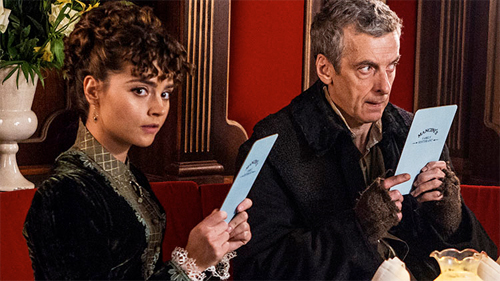
So… what did I think about Mummy on the Orient Express?

Posted on October 13th, 2014 in Culture | 1 Comment »

mummy

Doctor Who eras are defined as much by their titles as anything else. In the Hartnell years (mostly), individual episodes had names whereas whole stories weren’t given any identification on-screen. Thus, the story we know as The Aztecs was broadcast as four episodes titled The Temple of Evil, The Warriors of Death, The Bride of Sacrifice and The Day of Darkness. This has caused a great deal of confusion and controversy about the “correct” titles, which we need not go into now.

Once Troughton took over, simple descriptive titles became the order of the day. It’s about the Ice Warriors? Call it The Ice Warriors then. Set on a Moonbase is it? Wait a tick. The Moonbase will do. Pirates but they’re in space? How about The Space Pirates.

Once Pertwee settles in, the story titles get a bit more dramatic. Alien ambassadors? Nah, let’s go for The Ambassadors of Death. And the trend continued throughout the Tom Baker era. The Deadly Assassin. But aren’t all assassins deadly by definition? Shut up, it sounds great. Once John Nathan-Turner takes over, the story titles become a little more restrained – Full Circle, Black Orchid – or incomprehensible – Kinda, Castrovalva. One word titles become commonplace, especially one-word-two-word titles – Time-Flight, Snakedance, Earthshock.

Under RTD, the titles were far less predictable. Some hysterical – The End of the World – some evasive – The Empty Child. We had “The Doctor” in the titles for the first time and, with Smith and Jones, the letter J. But under Steven Moffat, and especially from Series 7 onwards, there has been an explicit desire on the part of the show-runner to make the title part of the marketing of the episode. What’s tonight’s Doctor Who about? Dinosaurs on a Spaceship! Who could not want to watch that? (Answer, anyone who has watched it once already.)

There’s nothing terribly wrong with that I suppose, but I find it very hard to forgive our illustrious show-runner for not transmitting Neil Gaiman’s brilliant, brilliant story under its correct title Bigger on the Inside.

So, I’m not a huge fan of Mummy on the Orient Express, as a title. It’s a poor gag in the vein of Rubbish of Sherwood, a weird mash-up of two ideas related only by being vaguely contemporary (Howard Carter’s expedition was 1922, Agatha Christie’s Murder on the Orient Express was published in 1934) and sounds rather like a penny dreadful. I was full of foreboding that the cataclysmic show-down between Clara and the Doctor would be ignored and I was jumpy at the prospect of Frank Skinner in a guest part.

The pre-credit sequence is perfectly fine, if rather wasteful of the great Janet Henfrey. A horrible and inexplicable death in the first five minutes is very traditional for Doctor Who, but when Clara and Capaldi emerge from the TARDIS bantering happily, my heart sank. However, this was merely a feint by the production team, since this is intended to be a final trip. Okay, fair enough.

An excellent guest cast fills out the remaining roles – David Bamber, Daisy Beaumont, Christopher Villiers, John Sessions and someone who apparently would like to be called “Foxes”. Plus, seeing Jenna Coleman in that plunging mini dress and then in those silky jamas made me feel a bit funny. Of course, this is the Orient Express IN SPACE!! I’m not quite sure why it has to be IN SPACE!! Except for the fact that not having to show trees rushing by saves on the budget as does not having anyone climbing around the outside, as is generally required of adventure stories set on trains.

The threat is a neatly insoluable puzzle and the Doctor’s approach to tackling it is very interesting. “Mystery shopper” is a cute way to undercut the power of the psychic paper. I’m not sure what suddenly stripping away the holographic set dressing adds to the drama – it did make the mise-en-scene a bit less interesting from that point on.

So, enter Frank Skinner. Far from the catastrophes of stunt casting past (Beryl Reid, Ken Dodd etc), Skinner underplays nicely, with a little twinkle giving away that there is far more to this innocuous engineer than at first glance. Alas, I spotted very early that his only dialogue is with the Doctor, and in a story where the main threat can only be perceived by the person about to die, it was a little too obvious that “Engineer Perkins” was actually a hologram whom only the Doctor could see.

Alright, actually that didn’t happen, but right up till the moment Clara turns to watch him leave the TARDIS, I was convinced it was going to. Watch the episode again – I swear, nobody apart from Capaldi ever acknowledges his presence. David Bamber says “shut that man up” at one point, but even that is ambiguous. Part of the problem is that we quickly get down to half-a-dozen non-speaking extras (if they have even one line of dialogue, you have to pay them more money) but still, I don’t think I’ve ever seen such a clear set-up for a payoff that never arrives before in my life.

Overall then, this is strong stuff. Yet another penetrating look at this darkest of all Doctors, his clear-eyed morality dramatically juxtaposed with his clodhopping bedside manner. An exciting, fast-moving adventure with a neat solution which manages to be tense and fun, all at the same time. An engaging group of supporting characters whom I actually missed when they fell foul of the Foretold and smart, pacey direction that holds the whole thing together.

What takes the shine off a little is Clara’s change of heart at the end. I am tremendously relieved that the events of Kill the Moon have had an impact on the episode(s) which followed, and I don’t object in theory to sending Clara on an adventure which causes her to do a complete volte-face and jump back on board the TARDIS, but I’m not sure this was that adventure.

Anyway, 4½ stars for what is shaping up to be a very strong run of episodes.

Taking a bit of time out and setting up 12 consecutive episodes as well as the remarkable coup of landing Peter Capaldi in the leading part really seems to have re-energised the production team from Moffat on down. Finally, he seems to be finding the balance between a really good story-of-the-week (and they have all pretty much been good-to-great, with the exception of Bobbins of Sherwood), and an engaging season-arc-mystery, while providing genuine character development between the two leads week-to-week.

It may have taken four and a half years and four seasons, but I think Steven Moffat might finally be getting the hang of this show-runner job. I can hardly believe we only have four episodes to go.

So… what did I think of Kill the Moon?

Posted on October 10th, 2014 in Culture | 7 Comments »

killthemoon

Newcomer Peter Harness begins his script in about the least promising way possible. The TARDIS – as well as not housing any hanky-panky – also ought not to be home to moppets. Moppets practically undid a Neil Gaiman script quite recently and I remain stubbornly uninterested on whatever tiresome journey of self-discovery Courtney Woods pleases to be on.

The arrival on the moon is visually stunning however. Really amazing. I’ve said before that the production values of modern Doctor Who are rarely an issue but this is another level. The location filming in Lanzarote, combined with some incredibly elegant pixel-shuffling from Milk, creates an incredible evocation of walking on our satellite. And I would have forgiven them for just ignoring the one-sixth gravity, but actually, the weight of the TARDIS crew turns out to be a plot point.

We then meet the Space Shuttle crew – Captain NotNamedOnScreen and her cohorts Lt FirstToDie and Cpl DontKnowDontCare – who are here with loads of nukes because – blowing up the moon is their last resort. The next twenty minutes is pretty standard run, jump and hide stuff. Some good jokes. Some good scares. Murray Gold, giving it some welly. And then, rather earlier than I expected, the truth is revealed. The moon is an egg. And it’s hatching.

Big problem with this episode #1: Pretty much all of the forgoing is utter bullshit from a scientific point of view.

But… c’mon #1: Basically, all the science in Doctor Who is bullshit. As an anthology show, Doctor Who can and does work in a lot of different genres, but “hard SF” is one it visits very rarely. Even if you give the essentially magical powers of the TARDIS and regeneration a pass, that doesn’t make past plotlines any more plausible. Just so we’re clear – you can’t power travel suits with static electricity, use mirrors to travel through time, maintain a corporeal body with the power of your will, alter the structure of the universe with maths, reassemble a shattered spaceship by gravity, grab a young American botanist with one of your branches if you’ve been turned into a tree, or expect a code-cracking computer to translate ancient languages either. No grand tradition of hard SF concepts has been traduced here, and the notion of the moon as an egg is beguiling, poetic, dramatic and visual. That’s good enough for me.

Building an entire episode around a moral dilemma is bold enough. Having the Doctor abandon Clara, Captain Cold Feet and Moppet to their own devices is incredible. Steven Moffat has talked about finding a Capaldi moment in each episode. Looking the Half Faced Man in the eye while pointing out that one of them is bound to kill the other springs to mind, so does he lack of concern with the fate of Ross in Into the Dalek. “Kill the little girl first,” is chilling enough – but his attitude to the humans here is nothing short of astonishing. Only the Fourth Doctor refusing to assist in the amputation of Winlett’s infected arm in Seeds of Doom even comes close.

Big problem with this episode #2: It’s an anti-abortion parable.

But… c’mon #2: No it isn’t.

Not enough for you? Okay, look of course, abortion flitted through my mind watching this episode, but I dismissed it almost as quickly. The debate here is about whether to murder an innocent creature which is already unequivocally alive. The fact that it is currently inside an egg-shell does not make this action an abortion. The abortion debate hinges on firstly the rights of the mother vs the rights of a zygote (there is no mother here) and secondly the difference between an undifferentiated ball of cells and a unique, viable life, capable of existing outside of its mother (evidently the moon-lizard-bat-thing has reached this point).

In the end, Clara flies in the face of the will of the people of Earth and pushes the big red do-the-right-thing button. We get an appropriately heart-string-tugging ending and –

Big problem with this episode #3: A newly-hatched creature immediately laying a new egg that’s bigger than it is…

But… c’mon #3: See #1.

And then Clara rips the Doctor a new arsehole.

Jesus Christ!

Possibly the rawest scene of the Moffat era, maybe in the show’s entire history, this isn’t the Doctor being a bit moody, this isn’t a companion having a grump, this is a full on, balls-out, emotionally scarring show-down. No companion – no character – has ever called the Doctor on his antics like this, and no incarnation of the Doctor has ever deserved it more. Finally, after a couple of very engaging false starts, the contemporary incarnation of Clara eventually gets something resembling a personality and Jenna Coleman finally gets a scene worthy of her talents.

The whole story is quite an achievement and I can feel my fingers nudging towards the five star key. It isn’t perfect, alas, and the biggest failing is the supporting characters. Hermione Norris grasps at a few flimsy clues in the thin dialogue and manages to carve out something resembling a human. Phil Nice and Tony Osoba do good work, but the script is far too eager to bump them off and so they never get a chance to register. Ellis George grates a little less this time round, but I’m still not absolutely convinced of the need for her to be here.

And I’m assuming the production team will remember that all this has happened and that life on board the Orient Express in Space (why?) on Saturday will in some way reflect this and not show the Doctor and Clara as pals again (I note no Coleman in the trailer). So, on that basis – and aware that the episode has Divided Fandom (no bad thing), I am all-in on Kill the Moon. Five stars. My first since The Girl Who Waited I believe.

So… what did I think of Listen/Time Heist/The Caretaker

Posted on October 2nd, 2014 in Culture | No Comments »

Terrible dereliction of duty around here lately, sorry about that. I think partly because none of these three episodes provoked terribly strong feelings in me. That’s not necessarily a bad thing. As Tat Wood acutely points out in the About Time series, the production team fatally forgot how to churn out good, solid, workaday episodes in the mid-eighties and it nearly ended the programme for good. That’s what these three are – good, solid, workaday episodes in their different ways.

So, for a start I’m not a Listen hater, nor do I think it really deserves to be spoken of in the same breath as Blink. It’s great to see Moffat sit down and write a non-special, non-arc episode and it’s generally good stuff. I don’t subscribe to the notion put forwarded by some bloggers that having Clara give the proto-Doctor nightmares is an enormous ego trip for the writer (“Isn’t my character special? Isn’t my character the most significantest ever?”) but I do think that having already been threaded through the Doctor’s timeline, she isn’t the best choice for this role.

I didn’t mind the Danny Pink soap opera stuff, but I was put out by the fact that an enormous amount of plot hinges on Clara wilfully withholding vital information from the Doctor out of utterly uncharacteristic embarrassment (as noted the part is horribly underwritten, but Jenna Coleman plays her with a forthright vigour which is completely at odds with this narrative choice). And I don’t mind that the whole story is a closed loop, accomplishing nothing by its end, because some of the individual moments are so arresting – notably The Thing Under The Bed Covers – but I desperately care that we were never told what the The Thing Under The Bed Covers was, and I can’t quite escape the suspicion that that question will be answered in a future episode.

Three and a half stars seems miserly for an episode that was so formally daring and so much fun to watch, but four seems over generous given its various flaws. Tell you what, because Young Danny was so brilliantly cast, I’ll bump it up to four.

I’ve had the same conversation with several people regarding the extraordinary find of two Patrick Troughton stories long thought lost (one episode still eludes us). Do you prefer the amazing ambition and individuality of Enemy of the World or do you find more to admire in the way that The Web of Fear is just like every other Patrick Troughton base-under-siege story but so much better? I’m in the latter camp – I can’t overlook the way Enemy trips itself up when the execution isn’t up to the ideas. So I’m perfectly happy with Time Heist being a pretty unambitious by-the-numbers script. It’s chief problem is that it isn’t quite as novel or original as perhaps it thinks it is. There’s actually precious little here we haven’t seen before and most of the twists are pretty easy to see coming. But it clips along very pleasingly, nothing is wasted, nothing is flubbed and it is novel to see the Oceans Eleven genre grafted on to Doctor Who. Four stars seems about right here too.

Finally, The Caretaker. All three of Gareth Roberts’ The-Doctor-Blends-In-With-Earth-Humans scripts have had some basic problems of plot credibility. It rarely actually seems necessary for the Doctor to have to blend in with Earth humans in order to solve the ostensible problem. Of the three, The Lodger is easily the best and Closing Time with its vile love-conquers-all-ending is handily the worst. The Caretaker sits in the middle. Again, it seems utterly unnecessary for the Doctor to either bother to dress up as a caretaker at all, or to be so brazen about it. Clara and Danny’s romance which was tolerable in Listen is really rather irritating here and the Scovox Blitzer is a remarkably generic and unthreatening creation which seems to have been designed by Kroagnon The Great Architect and which would have been much more at home in The Sarah Jane Adventures.

Whereas Time Heist was a romp with a bit of vinegar to balance it out, this is just larks and that’s hard to take over 45 minutes unless the level of invention and humour is absolutely top notch, and here it isn’t. The Doctor continually referring to Danny as a PE teacher is very funny, but the subplot with Courtney the cocky school kid is dull and goes nowhere. Danny Pink’s soldiering which had been a distant bell sounding every so often to punctuate the relationship now becomes a great clanging gong, drowning out everything else about him and the whole thing seems a little short on story for the running time. When it works, however, it works, and I have to give it props for Danny rejecting Clara’s absurd lies about rehearsing for the school play. Three stars seems about right.

So… what did I think of Robot of Sherwood?

Posted on September 11th, 2014 in Culture | 1 Comment »

clara-and-robin

I’m currently listening to a podcast about TV, wherein two (slightly clueless) American chaps discuss the series they are watching at the moment, both recent and current, and offer their views. These young guys have grown up with The Wire and The Sopranos and Breaking Bad and so it’s fascinating to hear them discuss Doctor Who. They’ve been going season-by-season, starting with Eccleston and they’re pretty down on some of the early RTD stuff, although – while they can’t stand Catherine Tate as Donna – they like it more and more as the David Tennant years conclude.

What they don’t seem to get – having never watched the “Classic” Series – is that unlike the heavily-serialised epics of modern US television, Doctor Who has always been designed as an anthology series. So when they complain (and they do) that one episode just seems to completely disregard a previous one, or that no-one has sat down and worked out a consistent chronology of the Whoniverse (no-one who works on the show at any rate), I just want to shout “that’s a plus, not a minus!”

Designing the show as an anthology is what has given it the flexibility to continually reinvent itself, not just Doctor after Doctor, or year after year, but episode after episode. Grim horror follows whimsical fairy tale, follows ripsnorting adventure, follows conceptual sci-fi. By avoiding serialised storytelling, the show constantly opens itself up to new avenues, and by not setting the characters out on a clearly-defined journey, it never needs to end. My big problem with the Matt Smith years was the show was trying to do far more serialised storytelling than was really good for it, and then not really committing to that either.

So, I don’t mind the fact that the supposed “darker Doctor” is taking a week off this week and I don’t mind the fact that this episode is explicitly designed as a “romp”. Both the classic and new series have provided some excellent “romps” including some of my favourite episodes. But this one didn’t really work for me. Unfocused, smug, and seemingly determined to undermine the Doctor at every step. Let’s look at how and why.

Clara’s desire to meet Robin Hood to begin with is utterly arbitrary, further underlining just what a perfect vacuum of a companion she is – by modern standards anyway. Having told her such a thing is impossible, the Doctor manages to land almost on top of the smarmy icon – so clearly something much more is going on here. No, it’s just a coincidence.

As we meet the Merry Men as well as the Outlaw himself, I am ready for one of two different outcomes. Either the promise of the title will be fulfilled and the Doctor proved to be correct – of course this person isn’t the real Robin Hood, that would be absurd – or we will discover that this is the real Robin Hood but that the reality is very different from the myth.

The story at first feints with the first of these – the sheriff’s ship is leaking Robinhoodmium into the area making everything all storybooky – but then parries with the contradictory revelation that, no, this actually is the real Robin Hood. But in that case, you have to give us the truth behind the myth. Simply reproducing the myth and having Peter Capaldi scoff at it is pretty much the Dame Sally Markham school of copy-and-paste scriptwriting.

And while Ben Miller’s performance was perfectly judged, I don’t quite understand what happened to the real sheriff or if there was a real sheriff or really what the hell is going on. I imagine we were meant to find the Doctor’s bantering with Robin amusing – why else have them both chained up for static minute after static minute in the middle of the story? If you did, I’m happy for you. I found Robin profoundly annoying and the Doctor petty and childish in completely the wrong way.

Towards the end, we get a nice shot of them using molten gold to create an intricate circuit to help the ship take off again – heading for the planet Seasonarcphrase. Obviously this requires the gold to be precisely arranged to create the right effect. Except when it doesn’t and the mass of gold aboard the ship is the only important thing, thus allowing Our Heroes to save the day by firing an arrow after it. None of this is properly thought through, none of it makes any real sense, none of it feels grounded or authentic and all of it is irritating, including the Doctor’s spoon-fight with Robin.

It isn’t completely awful. It looks good – as usual – Ben Miller is absolutely excellent and I did like the Doctor’s remote controlled arrow gag, but on the whole and especially after the first two parts, this is limp, throw-away stuff, and labelling it a “romp” can’t begin to redeem it. Better I suppose than Journey to the Centre of My Rectum or The Soggy Pirate Rubbish but that ain’t saying much. Two and a half stars


So… what did I think of Peter Capaldi?

Posted on September 1st, 2014 in Culture | 2 Comments »

deep breath

In all the general delight that Doctor Who is back (yay!) after eight months off our screens (boo!) and that we are getting an unbroken run of episodes this year (yay!) and in the atmospheric autumn months to boot (yay! yay! yay!), it seems to have gone unremarked upon that we are only getting 12 episodes plus the Christmas special instead of the hither-to traditional 13. Perhaps the sprawling 80 minute run-time of the season opener is to blame? If so, I’m not convinced that it’s a good trade-off.

New Doctor stories break into roughly two types. The first, largely out-of-favour now, shakes the Doc up a bit for the first 20 minutes or so and then plunges him in to an adventure which becomes the real point of the story. See Power of the Daleks, Robot and, if it counts, Rose. The other type makes the Doctor’s regeneration and new persona the main point of the story and although there generally is a threat which must be overcome, it’s usually a fairly minor one. See Spearhead from Space, Castrovalva and The Christmas Invasion. In these stories, the Doctor is off-stage, usually incapacitated, for part of the story, and much of the action deals with the consequences of this violent alteration of his body and mind.

Ever eager to have his intricately decorated cake and greedily devour it too, Steven Moffat has inevitably tried to use the extra running time to do both here, and the result is an episode full of marvellous moments, but with some very strange pacing and a couple of choices that seem rather too forced.

I noted around the time of Tennant’s departure the two very different positions adopted by the outgoing and incoming show-runners. “This is a death. The Tenth Doctor will die,” intoned Russell T Davies as he prepared to clear out his desk. “He’s the same man,” reassured Steven Moffat as he tried Rusty’s boots on for size. Now it’s Moffat’s turn to execute a Doctor and he’s no longer prepared to show the process as consequence free.

Capaldi makes an instant first impression, although he’s given fairly generic Moffat-Doctor stuff at first, when he isn’t being given fairly generic post-regenerative-Doctor stuff. There are some lovely one liners in the mix though, especially the bit about the Doctor taking micro-naps while other people are talking. While learning his lines, Jon Pertwee used to rip out all the pages which didn’t feature the Doctor. On occasion he’d wander into the rehearsal room grumbling “very thin script this week.” Once he decides to leave via the window rather than the door, the character starts to snap into focus. It’s around this time that the main science-fiction mystery plot starts to take over, but it’s also remarkable – almost profligate – that the story is willing to introduce a fully-grown tyrannosaurus rex stomping across Victorian London and then toss it aside as a mere curtain-raiser for the supposedly more interesting tale of alien impersonators. Terror of the Zygons didn’t have Moffat’s budget but at least Robert Banks Stewart had the sense to do those things the other way round.

But the middle part of the episode is largely unconcerned with threats sauropodian or other-wordly. Instead we tackle the question above head-on – is this the same man? Clara’s scene with Madame Vastra and her veil is an arresting, confronting and beautifully written answer to this question, serving both to give fans a new take on what regeneration is as well as gently reassuring the little ones that it’s okay to miss Matt Smith and give this new bloke with the scary eyebrows a chance.

The only thing which spoils this scene is that of all the companions the Doctor has ever had, it’s this one who gets to play this scene. Clara the Impossible Girl who has helped the Doctor in every regeneration he has ever had. Clara, who only two stories ago was hanging out with not two but three Doctors and seemed perfectly happy that they were all the same man. Clara who watched the regeneration happen before her eyes, and told the Paternoster Gang in no uncertain times who this wild Caledonian really was. It’s a nice scene, but it’s absolutely impossible to fit it into Clara’s character development so far.

On which subject, there follows another very nice scene in which the Doctor and Clara meet in that weird restaurant. “Game-playing narcissist” is a pretty odd description of the Doctor. “Game-playing” possibly describes the fourth Doctor, certainly the seventh, but “narcissist” sounds totally wrong. And just what has Clara ever done which earns her either of those titles? Clara still has yet to make any characterisation beyond the incomprehensible Impossible Girl nonsense and Jenna Coleman’s winning smile. But it is a nice scene.

Once the main sci-fi plot takes over, the pacing smoothes out and the threat is vanquished in a suitably satisfying manner, with just two little wrinkles. How striking, how fascinating, in an episode devoted to telling us who this new Doctor is, to end the adventure on such a profound note of ambiguity. Both outcomes seem profoundly unlikely – that the Doctor bodily ejected his clockwork nemesis or that such a single-minded automaton elected to terminate himself. I almost don’t want to know the answer – for once the question might actually be more interesting.

What did give me pause is the very final scene with the first appearance of Michelle Gomez as “Missy” who appears to run a version of heaven populated only by people who have died at the Doctor’s hands. This evidently is our season-runner and so far I’m dubious as to its worth.

I’d rather have had that than the very peculiar and unnecessary Matt Smith cameo. Everything was wrong about this. Just when we’d begun to accept Capaldi, his predecessor shows up, bringing back all those tedious memories. The kids who were so subtly reassured earlier now have the message rammed down their throats and the whole thing smacks of “we can so let’s not ask if we should.”

But I’m sounding awfully grumbly about an episode I did like a lot. Ben Wheatley directs with atmosphere and class, the Paternoster Gang are huge fun as ever, Capaldi nails it right from the off and the new TARDIS and titles are lovely, even if the theme music is a bit Dominic Glynn. 3½ stars sounds about right. A promising beginning.

into the dalek

So, let’s go on to what should be an easier job – Capaldi’s second story. There’s not so much to say about this one – Fantastic Voyage inside a Dalek. This aims pretty low – a rollicking adventure with a thin veneer of moral philosophy – but it hits the bullseye pretty much every time. Twelve’s rescue of Journey Blue and his disregard for the fate of Ross are particularly striking. Some of this is by-the-numbers – she’s a soldier but she’s got a conscience (yawn) – some of it feels a bit over-familiar – a lot is cribbed from the end of Dalek, and visually its reminiscent of the Battle of Canary Wharf – but it’s fast-moving, funny, exciting and novel enough to be a thoroughly entertaining 45 minutes of television. Hardly likely to go down as a cast-iron classic but the kind of high-quality work-a-day story which the production team needs to be able to crank out.

The joint writing credit for Phil Ford and Moffat is interesting too. Is Moffat scaling back or is he doing RTD style rewrites now but taking a bigger credit for them? Only Ford was taking the credit on Doctor Who Extra in any case. I can’t quite bring myself to give a shit about Danny Pink, but I daresay he’ll be given something interesting to do at some point.

So, I’m optimistic at the moment. We haven’t managed a complete break with the past (I really don’t care who that woman in The Bells of St John was) but we’ve so far avoided the tangled continuity webs and nonsensical plotting of Time and Day of the Doctor and Capaldi is marvellous in the part. Four stars for Into the Dalek and away we go…

Sundance 2014

Posted on May 8th, 2014 in At the cinema, Culture | No Comments »

Deborah and I spent the weekend at Sundance watching five films and seeing four panels in three days. No, we didn’t go to Utah – for the last few years Sundance has come to the bizarre environs of the O2 so we were able to catch the latest in independent film without leaving London. I won’t go through the panels, except occasionally if they’re relevant, because panels are one-offs, but here are the movies we saw.

Obvious Child (wd. Gillian Robsepierre. Jenny Slate, Jake Lacy, Gaby Hoffman)

Our first film is so indie it almost hurts. A simple, unambitious tale of a newly-single stand-up comedian (Slate, familiar from Parks and Recreation) flailing around through something approximating adult life. Wistfully amusing, rather than laugh out loud funny with fun cameos from the likes of Richard Kind and David Cross, the main plot when it emerges might shock America’s conservative heartland but seems unremarkable in liberal London Town. The same goes for Slate’s “earthy humour” (i.e. fart jokes). Obvious Child works but aims fairly low, which I suppose is better than wildly overreaching but it made for a rather low-key start to the Sundance experience.

The Case Against 8 (d. Ben Cotner, Ryan White)

After panels about film music and “finding your story” we were back in the cinema for what was the undoubted highlight of the whole Sundance experience. When Californian voters passed “Proposition 8”, overturning the state’s recent commitment to gay marriage, young filmmakers Cotner and White followed the legal proceedings instigated by the American Federation for Equal Rights. For over four years, through endless appeals, the legal process ground on and Cotner and White’s extraordinary access documents the whole thing. Elegantly streamlined to a sub-two hour running time, the whole film is expertly judged, full of humour, insight, emotion and brilliant storytelling. A fascinating account of a vital human rights battle which deserves the biggest possible audience.

Hits (wd. David Cross. Matt Walsh, James Adomian, Meredith Hagner)

Things took an immediate turn for the worse later on Saturday night. Hits is the directorial debut of Arrested Development’s David Cross and it bears all the hallmarks of a sketch comedy writer and actor trying to tackle a full-length narrative for the first time. Hits is beset with problems, from the tonal to the structural. The story of a young woman who lusts for talent-show fame, it cannot find a focus, immediately shifting point-of-view to whomever happens to be in the frame, with the result that no coherent narrative emerges. Rather, it feels as if five different films are fighting for dominance. Compounding the problems, the satire is years if not decades old, and piss-weak, with an extra dose of supposed shock-value at the end doing nothing to pep the film up. But these weakness might have been overcome were it not for the fact that writer-director Cross so evidently loathes and despises all of the characters, from the bitchy local official to the idiot racist dad to the self-obsessed hipsters. In his panel with David Wain (read on), Cross earnestly told the audience that he took jokes out of the script to protect the story. In my view, the story wasn’t worth preserving, even if it had been structured with more discipline. A welter of funny jokes might have been a saving grace, but we are denied even that. Awful. Avoid.

The One I Love (w. Justin Lader, d. Charlie McDowell. Elisabeth Moss, Mark Duplass, Ted Danson)

The best fiction film we saw, this nifty drama sees Mad Men’s Moss and husband Duplass bundled off to a weekend retreat for couples in need of reconnecting. Once there, they… man, this film is hard to describe fairly. Let’s just say that some weird shit goes down and leave it at that, shall we? The film expertly judges the tone, presenting the aforementioned weird shit simply and effectively and mining the premise carefully and satisfyingly, while the two leads tackle the often difficult material with grace and style. Only in the last ten minutes, when the filmmakers become a little too interested in the mechanism of the premise does the movie even threaten to go off the rails, but by that time I had had too good a time to care much. I will be fascinated to see how this one is marketed and how well it does at the box office, but if it comes to a screen near you, I urge you to go and see it while reading as little about it as you possibly can.

They Came Together (w David Wain, Michael Showalter; d. Wain. Paul Rudd, Amy Poehler)

Significantly less ghastly than Hits, this was still a disappointment. A spoof romantic comedy, this isn’t quite the all-out joke-fest of Airplane and it’s ilk, but it’s far too broad to be genuinely romantic in the way that Scream was genuinely scary. Good jokes (Poehler and Rudd frolick in autumn leaves, oblivious to the mouldering corpse buried just under them) sit next to poor jokes (Poehler’s approach to running her candy store is just to give all the candy away, because why not) but often the demands of the narrative lead to joke-free passages where the thin nature of the material becomes painfully apparent. Even the good jokes aren’t always capitalised upon which is particularly remarkable and disappointing. The line between characterisation and running joke is a very fine one in a movie like this, but even when Poehler’s character is identified as an adorable klutz, and Poehler very amusingly pulls a load of boxes down on her own head apparently on purpose – subsequently this trait is never referred to again. Much of the time the laughs come from characters smugly commenting on the tropes they are enacting, in the way which might seem witty in an improv setting, but here just seems a bit laboured. Every so often there’s a performance or a gag which threatens to make the whole thing worthwhile, but ultimately this is weak sauce.

Short Film Programme

We rounded off Sunday night with one of two short film programmes. Rather than go through all the ten-or-so shorts we saw, I will pick out two favourites. Firstly I Think This Is the Closest to How the Footage Looked (d. Yuval Hameiri). In this haunting piece, a young man reenacts the last hour’s of his sick mother’s life with household objects. The reason for the reenactment becomes devastatingly clear half-way through. A huge emotional bang for barely a single buck, Hameiri’s film is a tiny triumph of feeling over resources. More traditional in form is the Irish documentary The Last Days of Peter Bergmann (d. Ciaran Cassidy) which uses interview and CCTV footage to document the meticulous preparations of an unknown man who checked into a hotel in Sligo, Ireland, using the fake name Peter Bergmann. A 20 minute human mystery that may never be solved, Bergmann is a touching riddle, a fleeting enigma, a tiny treatise on how to take charge of matters which no-one can truly control.

All the Sundance staff (though not all the O2 staff) were friendly and helpful and although we felt a bit abandoned to the tender mercies of a dozen or so chain restaurants in the TGI Fridays vein when it came to food and drink, we left the festival inspired, invigorated and largely entertained.

Some shows you should maybe watch

Posted on April 23rd, 2014 in Culture | No Comments »

So, Breaking Bad has gone, everyone who wants to watch The Wire and The Sopranos has, True Detective was over almost before it began and you don’t need me to tell you that you should be watching Game of Thrones. What else should you be watching, both from the US and from home? Here are some suggestions.

The Good Wife

goodwife-longOver here, this has completely flown under the radar. The pilot episode, and basically the whole first season, doesn’t make it seem all that special. It’s a network drama and it’s on CBS, arguably the most conservative of the big American networks. It stars Julianna Margulies off of ER as Alica Florrick who returns to a career as a lawyer, starting from the bottom again as a junior associate, when her big-shot politician husband goes to prison following a very public sex scandal. And for the first year or two it just kind of motors along, equal parts snappy case-of-the-week “I object” “in my chambers” TV courtroom stuff, and some more soapy material about Alicia’s kids and her sexual tension with senior partner Will Gardner. Fun, but hardly great. Some time around the third season, it slowly starts to become bolder, quirkier, more subversive, more willing to upend the whole premise of the show for an episode, a few episodes, a season. Add to this an amazing roster of guest stars including Alan Cumming, Michael J Fox, Carrie Preston, Nathan Lane and Martha Plimpton to name only a handful and you have probably the best TV law show since Boston Legal and arguably the best American network drama currently on the air.

Watch it on DVD from Amazon, download it from iTunes or watch it on More4.

Orange is the New Black

orange-is-the-new-black

Probably the best of the Netflix originals, far better than the rather unsatisfactory Arrested Development episodes and nosing ahead of the fascinating and handsome but compromised House of Cards, this had an amazingly good run of episodes in its first year and its return is eagerly awaited by me at least. Based on the book by Piper Kerman, it tells the story of a seemingly-normal middle-class blonde WASP about to get married, whose reckless past catches up with her in the form of a 14 month jail sentence. The series carefully balances social comment with behind-bars melodrama and once again we have a cast to die for, including USS Voyager’s Captain Janeway in a red fright wig and full-on Russian accent.

Watch it on Netflix or buy the DVD from Amazon, but quick – the new series lands on 6 June.

Justified

justified-season-four-timothy-olephant-500-fx

Based on a short story by the late lamented Elmore Leonard, this gunslinging melodrama is more contemporary than it feels. Masterminded by Graham Yost (Speed), this FX series stars Timothy Olyphant as US Marshall Raymond Givens who is too quick-on-the-draw for his Florida bosses and so has his ass transferred back to his home town of Harlan County, Kentucky. There he meets up with old sparring partners, including his no-good dad, and makes some new friends, enemies and frenemies. Largely an adventure series, but brilliantly plotted at its best, it benefits from some deeper more thoughtful characterisation, ending up with that delightful Breaking Bad mix of plenty of high-stakes but plenty of depth too. While it can’t quite claim to scale those heights, this is much, much more than case-of-the week procedural stuff. The first series is a bit bumpy, struggling to find a through-line, suffering from an obsession with religion which never arrives anywhere interesting, and saddled with characters called Bo Crowder, Boyd Crowder and Bowman Crowder to add to the confusion. Only Boyd is really interesting or relevant. The second series is a dramatic improvement with the arrival of the splendid Margo Martindale as the Big Bad Mags Bennett. The third season is almost as good and the fourth is the best yet. The fifth isn’t quite as satisfactory, but the last episode makes it clear that this was really the first half of the final season. Catch it now before it finishes next year.

Download from iTunes or buy the DVD from Amazon. Channel 5 was running it here but has now dropped it.

The Americans

Emmys-The-Americans

Another FX series, struggling to find its feet a little, but quietly growing in confidence and with a crackerjack premise. Keri Russell and Matthew Rhys star as Elizabeth and Philip Jennings, an apparently ordinary suburban American couple living in Washington DC in the early 1980s, looking after their two kids and running their travel agency. In fact, both were born in the Soviet Union and have been placed on US soil by the Kremlin to run covert missions for the mother country. Both leads are great, sporting an array of wigs and disguises, and the run-of-the-mill jumping, shooting and hiding in cupboards is given an extra frisson by the fact that our “heroes” are on the “wrong side”. As the series continues, it becomes clear that almost everyone on almost every team is compromised to some extent, and of course we get the irony from our twenty-first century perspective that the very thing the Jennings’ are fighting for will eventually be abandoned by those asking them to risk their lives for it. Not all the characters are quite “popping” as they should yet, but the series shows a lot of promise and has already been renewed for a third season.

ITV1 is showing the second series at the moment. Buy the first series on Amazon or download from iTunes.

Nurse Jackie

nurse-jackie-season-2-hospital-500x300

Moving over to Showtime, we find Nurse Jackie, or what Edie Falco did after The Sopranos finished. In one of the best pilots of 2009, we meet New York nurse Jackie Peyton, whose attitude towards her job is one of compassionate pragmatism as her personal life gets ever more complicated. To say a lot more would be to undo the elegant structure of the opening episode which continually reveals layer after layer of this fascinating character. Comparisons with House are obvious for various reasons, but Nurse Jackie has a much more cheerfully comic tone and among a tremendous supporting cast features a total stand-out in the form of Merrit Wever as Zoe Barkow, a true original in every respect. As the seasons go on, Nurse Jackie faces the same problem as House – the more the series forces the protagonist to confront their personal issues, the greater the risk of breaking the series for good. Following the departure of original show-runners Liz Brixius and Linda Wallem after Season Four, Season Five hit the reset button pretty hard in order to keep going but the current sixth season seems to be finding an easier groove.

Sky Atlantic has been showing the fifth season and go of course buy it on Amazon or download it from iTunes.

Rev

rev

And finally, why not something home-grown? Tom Hollander and James Wood’s sitcom about an inner city C of E priest is far from The Vicar of Dibley with testicles. The first two series were funny, heartfelt, well acted and nicely judged. Hollander’s central performance is funny without being cartoony but the more overt acting styles of Miles Jupp and Simon McBurney (Simon McBurney!!) give him energy, while he grounds them – it’s very very clever. Add Olivia Colman as Mrs Vicar and a smattering of largely deadbeat parishoners and there’s a lot to enjoy. But this third series, arriving after a three year gap, has been nothing short of superb, almost apocalyptic in the woes and suffering it has heaped upon Adam Smallbone.

Series Three is finishing on BBC Two and is available on the BBC’s iPlayer. A boxed set of the first two series is available now and a set of all three is coming soon.

That’s enough for one post. Also worth mentioning are Louie, Orphan Black, Portlandia and Veep. Shows I’m watching but can’t really endorse include Helix, The Blacklist, Trophy Wife and Mom.

Oscars 2014 – Her

Posted on February 15th, 2014 in At the cinema, Culture | No Comments »

tumblr_mwegtxKybm1so4uy2o1_500

Some spoilers – be warned.

As previously noted, I thought this was a dreadful idea for a movie. Electric Dreams seemed facile and absurd in 1984, but computers being so much more commonplace in 2014, we know so much more about their strengths and limitations now which makes a movie like this very, very tricky to pull off. Anyone who has talked to Siri for any length of time will no doubt have been delighted by the wit of some of the reponses and will also have been frustrated by the system’s inability to parse what would seem like very simple instructions to another human.

And yet, from this thinnest and seemingly most unproductive of premises, Spike Jonze as writer and director has created something rather magical. This sweet, sad, odd, funny, charming, moving film is by no means perfect but it is one of the most purely original and beguiling films of the year, and I think earns its place come Oscar time, albeit in the “also-ran” category.

The pitch is as follows – sometime in the near future, when trousers are worn extremely high and writing sappy letters on behalf of other people is a full-time job, a new operating system will be developed which has full artificial intelligence and which is expressly designed to interact with you. Theodore Twombly, whose personal life is a disaster, purchases and installs this software, creating a virtual companion for himself, named Samantha, whom he proceeds to fall in love with.

There are numerous pitfalls here for an unwary director. The first is to make the software convincing. By beginning the story in a future world, where video games take up half the living room and where natural language interaction is the usual way of issuing instructions to personal computers, Jonze creates a very useful credibility stepping-stone from the limitations of today’s devices to the unlimited processing powers of Samantha. The second is to avoid it being creepy. If we feel like Samantha is a made-to-order psychological prostitute, we will lose sympathy for the lead character very quickly. Jonze carefully lays the groundwork, confronting Twombly with a genuine creep in the form of a very funny voice-only cameo from Kristen Wiig as one “SexyKitten” whom Twombly meets in an online sex chat room. But he is also helped enormously by Joaquin Phoenix’s performance, which is suitably off-kilter – a straight-arrow leading man actor like Matt Damon or Tom Cruise kills the movie dead – but also achingly vulnerable and uncertain.

It’s also clear that – as far as Jonze is concerned – this isn’t really a science fiction movie. The world-building is all relegated to the background, we have no idea what breakthroughs have made this technology possible, and the details of how “Samantha” works are glossed over (the interview which the installer conducts is over with almost before it’s begun – this isn’t a made-to-order perfect woman unless the company has been spying on Twombly for months). And there’s no broadening of the scope of the story to show, for example, the company which created this software getting wiped out on the stock exchange when all the sentient OSes suddenly decide to “leave”. Sometimes, this refusal to remove the narrative blinkers is a weakness. When Samantha goes off-line, leaving Twombly to panic and rush his hand-set to the IT emergency room, she blithely replies on her return that she had sent him an email informing him of her forthcoming absence. Fine, but how is he expected to read an email without an operating system?

However, when the ramifications of this “magic bean” intersect with the human drama which is unfolding, then the follow-through is admirably thorough. Human/OS romantic relationships are, if not taken for granted, certainly expected and talked about. Of course! Of course Theodore wouldn’t be the only one to become intimate with his gracefully personal personal assistant. An OS has more in common with another OSes than with a human master. Of course! And of course they would be able to communicate effortlessly with each other in this connected world.

The limited scope of the movie puts a lot of weight on a relatively small cast. As well as Phoenix, Jonze casts Rooney Mara as Twombly’s ex-wife, Chris Pratt as his work buddy, Olivia Wilde as his blind date, Amy Adams as his best gal-pal and – apparently – a 25-year-old David Hyde Pierce as her husband. All do excellent work, especially Wilde who makes the most of a two-scene cameo. Amy Adams is on fine form too, far less glamorous then in American Hustle but equally compelling.

As Twombly blunders through misunderstanding after crass remark, he is permitted some moments of happiness, even joy, in Samantha’s company and Scarlett Johansson also does lovely work as the voice of the software. It’s these scenes which give us hope for the future. Twombly’s relationship with his computer may have been a horribly misguided, fucked-up, dead end (nowhere more clearly demonstrated than in the extraordinary scene where Samantha procures a sexual surrogate to consummate her and Theodore’s love) but it helped heal some wounds, and Theodore ends the film if not having been made whole then at least having learned to feel again, to laugh again, to share again.

With a lovely and very distinctive soundtrack from Canadian band Arcade Fire, Her is a very carefully controlled piece of work – delicate, intimate and precisely focused. By avoiding really exploring the wider consequences of the creation of an army of Samanthas, Jonze is able to tell a deeply personal story about one man’s struggle against loneliness. But it’s still occasionally frustrating to get only tiny glimpses of another, broader, more technological but no less interesting, story happening outside the frame. Whether it would have been possible to set such a fragile love story in this wider context is unanswerable. What’s clear is that Spike Jonze achieved exactly what he set out to, and the result is rather lovely.

Oscars 2014

Posted on January 18th, 2014 in At the cinema, Culture | 2 Comments »

It’s Oscar time again. Ladies and gentlemen here are the runners and riders…

The ones I’ve seen already…

Gravity

Tying with American Hustle for most nominations (ten, one more than 12 Years A Slave) it’s perhaps a little surprising to see this getting quite so much Academy love. Pared-back and innovatively-shot it may be, but it’s still essentially a blockbuster thrill-ride at its core. What’s even more surprising is that it hasn’t been overlooked in the “big six” department. Alfonso Cuarón is nominated for Best Director as is Sandra Bullock for Best Actress. To be honest, I don’t think it has much of a chance in any of these categories, except possibly Best Picture ironically. I wouldn’t give myself odds of better than 4-1 but since Paddy Power was offering 12-1 I’ve put a tenner on it. My full review is here.

Captain Phillips

Another one-person-against-the-odds movie (Robert Redford’s All is Lost didn’t get a nod), Paul Greengrass makes a huge virtue of his lean, documentary shooting style and Tom Hanks makes an appealingly unsympathetic hero – although his real-life crew insist that the real guy was even a bigger asshole – but what knocked me out is the total collapse of the Captain Phillips character when the ordeal is over. Tom Hanks’ raw, authentic, bewildered inability to cope with his recent experience is some of the very best screen acting I have ever seen and his failure to be nominated is utterly confounding – especially when antagonist Barkhad Abdi has got a nod for Best Supporting Actor. This is not to take anything away from Abdi’s performance which is very fine, but Hanks’ snub would be easier to understand if the Academy had failed to notice any of the acting in the movie. Anyway, this won’t win the big prize.

Philomena

A delightful, personal, and very moving film showcasing a completely different side of Steve Coogan, who abandons Partridge-style mugging completely to carve out a much more detailed and intimate portrait of a journalist whose compassionate zeal never tips the story into mawkish sentimentality. In fact the whole film pulls off a very delicate balancing act between humour, soap opera, detective story and politics. The detective story is the loser, but it’s by far the least interesting and necessary component. Judi Dench also gets yet another acting nomination. Nothing for Coogan as actor (which would have been surprising but not wholly undeserved) but the screenplay gets a hat-tip.

Nebraska

Alexander Payne continues an extraordinary run beginning (for me at least) with the brilliantly spiky Election, continued with the more subdued but still excellent About Schmidt, the splendidly freewheeling Sideways and the truly marvellous The Descendents which readers may recall I favoured over eventual Best Picture winner The Artist. Nebraska is a very, very simple story. In fact my only real criticism is how noisily the plot gears were grinding in the first twenty minutes to achieve its fairly straightforward set-up, viz – septuagenarian Woody Grant mistakenly believing himself to have won a million bucks in a sweepstake stops off in his old home town en route to collect his winnings.

As soon as we arrive in Hawthorne, however, we are off to the races as Woody reunites with old friends, family and rivals, most of whom are eager to get their hands on his new-found dough. Accompanied by his son (SNL’s Will Forte – a revelation), and eventually his wife (June Squibb, delightful) and brother (Bob Odenkirk), Woody drifts through much of the movie in somewhat of a senior daze, but this lack of desperate questing serves to give the rest of the movie time to settle. Much of the dialogue is peppered with one-liners, but nothing ever seems forced, except possibly the final pay-off which is just a little too neat.

Immaculately shot in cool, grainy black-and-white, this is a real treat and it’s great to see “little” movies like this and Philomena getting the Academy’s attention as well as the big spectaculars, all-star casts and “important” movies – see below.

The ones I haven’t seen yet…

American Hustle

A strong contender in the three horse race for Best Picture, only a year after Silver Linings Playbook, director David O Russell assembles much of the same cast and gets them nominated in all four acting categories again. I was dissatisfied with Silver Linings because I felt the ending sold the characters down the river. Early reports of this suggest that the plotting also goes awry towards the end, but we’ll see. Like Argo, this could make it if the Academy finds Gravity too frivolous and 12 Years A Slave too self-important.

Dallas Buyers Club

This is the one I know the least about. Part of the recent rehabilitation of Matthew McConaughey which began with 2012’s rather unsatisfactory The Paperboy, it also stars Jared Leto as a transgender character and follows the tale of a drug smuggler – not cocaine but untested HIV pharmaceuticals. It’s released in the UK on 7 February so look out for a full review some time after that date.

Her

One of the worst ideas I’ve ever heard for a movie, grinding through the unproductive furrow of the wretched S1m0ne, and the absurd Electric Dreams as well as the ghastly AI and the limp Bicentennial Man. I didn’t see Robot and Frank so maybe that was better. On the other hand, this is Spike Jonze who can usually relied on to be interesting, so let’s give it a whirl. It’s released here, appropriately enough on Valentine’s Day.

The Wolf of Wall Street

I can’t remember the last time I looked forward to a Martin Scorsese movie this much. I couldn’t get on board with The Departed which began by examining the mirror-image moral conundrums faced by a cop-turned-mobster and a mobster-turned-cop, then turned the movie over to Jack Nicholson who proceeded to Nicholson all over the middle third. After his character’s demise, the afore-mentioned moral conundrum is entirely lost in a welter of gunfire and bodies hitting the decks. It scarcely seems to matter what moral choices any of these characters make, today everybody dies. Completely pointless in my view. Shutter Island was diverting but ultimately a rather empty puzzle-box picture, and Hugo was very disappointing (full review here). This, on the other hand, seems to have a much clearer direction to head in, a crackerjack cast and – hey! – jokes! I doubt it will sweep the board though, in what is looking like a pretty strong year.

12 Years A Slave

And here it is – the bookies’ favourite and the likely front-runner, but it remains to be seen after Django Unchained, Lincoln and The Help how much more guilt-porn the Academy can take. It also remains to be seen if it’s any good. I haven’t seen either The Hunger or Shame but I’ve heard extremely mixed reports about both. 12 Years has been largely praised by critics and has done decent box office, but I worry that it will be too worthy and not engaging enough as a piece of narrative.

What wasn’t nominated

As well as All is Lost missing out, I had expected to see Inside Llewyn Davis get a mention and possibly August: Osage County. I feared that the execrable Blue Jasmine would appear and vaguely wondered if The Butler was in with a chance. Although I loved Saving Mr Banks and although the Academy generally appreciates Hollywood-devours-itself movies, that film always looked too… breezy to be in with a chance. In fact, the breezy parts I liked the best. When it attempts to wring psychological depth out of a piece of fruit, and when we spend endless tediously repetitive minutes cavorting with Colin Farrell in what is meant to be small-town Australia, I want to check out.

Other predictions…

If it all goes Steve McQueen’s way, and it still could, then Chiwetel Ejiofor has a good chance for Best Actor and McQueen himself for Best Director. Best Actress is probably going to Cate Blanchett – it’s hard to overlook such a stellar performance if, like me, you didn’t think much of the script. For people who liked the rest of the movie, it must have seemed virtually god-given.

As is often the case, the supporting nominations are a little more open. Michael Fassbender is probably the front-runner, again for 12 Years A Slave, but I wonder if Jared Leto might just nick it. For Best Actress, June Squibb must be a good bet. The Academy loves them some old ladies and if those old ladies are on film lifting up their skirts in a graveyard in order to taunt an old suitor in his grave, so much the better.

Best Director will probably go the same way as Best Picture, so if they give it to Alfonso Cuarón, and your bookie is still open, put a big bet down on Gravity immediately. On the other hand if, as seems more likely, it isn’t Gravity’s night, I can see these two awards splitting between Slave and Hustle although I’m not sure which way around is more likely.

Finally, screenplays and as usual we have two bites at the cherry as the Academy distinguishes (sometimes eccentrically) between original screenplays and adaptions. In the Original Screenplay category, I imagine American Hustle has it sewn up, and likewise I would expect Adapted to go to 12 Years A Slave. If, say, The Wolf of Wall Street pinches Best Adapted Screenplay, we could be in for some 3:00am surprises.

Okay, that’s where we’re at. More reviews coming soon.

So… what did I think of Name/Night/Day/Time/Space/Hat of the Doctor?

Posted on December 26th, 2013 in Culture | 2 Comments »

cyber-handles-christmas-special-2013

To begin with, the fiftieth anniversary was an extraordinary milestone, celebrated in style. The tweedily earnest Matthew Sweet documentary was lovely; the Mark Gattiss drama was charming and moving, if unseemly brisk; the Peter Davison red button extra was properly hilarious and the Paul McGann mini-episode totally unexpected and absolutely extraordinary. Over the BBC Three post-show party, I must draw a polite veil in the interests of propriety.

What then of the episode itself? Hardly the direct continuation of the Series Seven finale I thought we had been promised. You’ll remember, if not really comprehend, that the Doctor and Clara were trapped, seemingly forever, in some bleak landscape of the Doctor’s own timeline, with no possible means of escape, and facing a hitherto unknown Doctor whose baleful powers were terrible and absolute. Hell of cliffhanger to leave us on. And resolved by – ignoring it completely. Oh well, maybe they weren’t quite as comprehensively trapped as they had seemed. Maybe there was an escape pod (there frequently is).

What we do get is a lovely widescreened version of the original titles, a glimpse of Coal Hill School where Clara The Impossible Girl (I think that’s her surname), her baffling reason-to-be having now been discharged, is working as a teacher. For reasons not clear even when explained, Kate Lethbridge-Stewart finds it convenient to very, very publicly air-lift the TARDIS to UNIT’s top-secret headquarters in order to explain some plot.

And now we meet the other Doctors. David Tennant slips back into the role so effortlessly that it’s easy to miss that Moffat has fallen into the same trap as Bob Baker and Dave Martin, Terrance Dicks and Robert Holmes have before him. The returning Doctor is not written quite as we remember him, but as a rather broader, almost parody version. Tennant’s speech to the bunny rabbit is properly hilarious, but I can’t imagine RTD letting it through under his watch.

“The War Doctor”, as we must apparently call him, is more problematic for various reasons. Firstly, it seemed pretty obvious to me, and Moffat has now confirmed in interviews, that if Eccleston had agreed to come back, this would have been his part, and just as the “together, we’re a match for you” scene in The Five Doctors stumbles a little because Tom isn’t there, so too do the scenes of the three “modern” Doctors creak because we know one of them is a retrofitted interloper.

Far more damaging is the depiction of the Time War itself. As a phrase, as a concept, this fills the mind with all sorts of terrors and wonders. Once shown on the telly it looks like a video game. As another commenter pointed out, the Time War was introduced by Rusty to avoid all the continuity baggage of the Time Lords, but has now become that very continuity baggage.

Pretty soon, The Moment, cheekily played by Billie Piper, is chatting idly with John Hurt – which creates its own problems; surely the Eccelston Doctor would have recognised her in 2005 from this earth-shattering encounter? And before long all three Doctors are cheerfully shooting the breeze. There are some very, very funny lines here, some lovely nods to the fans and some signature Moffat touches with the sonic needing all that time to perform the calculations. And something about some Zygons. But around this point, I began to wonder – where is the urgency? Where is the jeopardy? Where is the threat? Have we finally put The Terrible Apocalyptic Time War on screen in order to turn it into a slightly dull undergraduate ethics class?

The problem is that the notion of wiping out Gallifrey in order to spare the universe, firstly is not adequately spelled out. It’s not really made clear what the Moment is going to do, nor what the alternative is. Secondly, the cost of either choice, not in terms of Universal Armageddon – such a thing is literally inconceivable and therefore undramatic – is not really apparent because the Hurt Doctor is so stoic. Compare his vague mulling over possible outcomes to the agonies which the Eccleston Doctor goes through in The Parting of the Ways as he attempts to decide whether or not to use the delta wave generator. It’s essentially the same plot device, but the extra power of the Davies’ version is hard to miss.

At some point, the Zygon plot rears its head again (even in 75 minutes it feels like there is at least one major plot-line too many here) and the solution provided is genuinely clever and arresting. Such a shame we can’t stick around to see the outcome. And then we pluck Gallifrey out of existence in a Blink-style manoeuvre in order to redeem the War Doctor while not quite unravelling the last eight years of television.

Quite apart from the fact that the entire Dalek fleet simply would not be eliminated in the crossfire, this is a shameless attempt to have one’s cake and eat it too. It undermines the very concept of actions having consequences. It undermines the whole idea of an incarnation of the Doctor who would do unthinkable terrible things (we never see this, the worst he does is graffiti a wall). It undermines the whole idea that the Doctor is alone in the universe. And it doesn’t even make sense.

The scene with the curator is lovely, (now you turn up, do you, Tom? Where were you in 1983?) and the Doctors Assemble shot is a magnificent summation of the series, if slightly-iffy effects-wise and it brings to an end a frustratingly uneven episode. The Fiftieth Anniversary Story had to be so many things to so many people it was almost doomed to fail. It had to be a love letter to the fans, in which it really did succeed. Just by putting Tennant back in the suit, it stood a good chance of doing that, but we got so much else besides. And it had to be an epic turning-point in the history of the show and to tell a really good story. It largely failed in both of these because the former undermined the latter. Take out all the Gallifrey stuff and have Ten and Eleven joining forces to battle the Zygons and you probably have a really good hour. Even with all the Gallifrey stuff, it might have worked if there had only been a greater sense of urgency – if Moffat had been able to make the awful choices faced by his heroes actually feel awful and then avoided that “with one bound they were free” ending.

But Moffat’s work is not yet done. The Christmas special also awaits in which supple, mercurial Smith must give way to Caledonian Capaldi. As is traditional, we start with a companion’s family. As is far from traditional, we also start with a slightly off-colour gag about the Doctor’s nudity. It’s odd that despite two return visits to Clara’s estate (see below) and the plot going to great lengths to remove Clara’s clothes as well, we never get the expected pay-off of both time-travellers returning to Christmas dinner in the altogether.

Thousands of ships are massing around a planet, bewilderingly identified as Gallifrey, later identified as Trenzalore – grave of the Doctor. Sepulchral voices demand to know “Doctor Who?” and so the Doctor has to go down and investigate. Clara and Eleven find themselves enveloped in a truth field, a startling idea which might give rise to all manner of best-kept-hidden secret hopes and fears but which is subsequently entirely ignored.

In fact, what they have discovered is a crack in time, the same crack which was first seen in Matt Smith’s debut episode, The Eleventh Hour, through which the Time Lords are now calling. Before this episode aired, Moffat promised that many unanswered questions would finally be addressed in this story. Good news, if like me you found the endings of the previous three seasons all utterly confounding. But we are no clearer now about what the hell was happening on the shore of Lake Silencio, or just how Amy Pond was able to reboot the universe by getting married, or what Clara Oswald was actually doing which made her so impossible. Instead, various elements of the previous three years are treated more like running gags to be mentioned briefly and occasionally connected to each other, while shedding very little light on anything.

The plot gears grind on and before long place the Doctor in a suitably impossible situation. If he speaks his name, the Time Lords will emerge and the Time War will start again. If he doesn’t the massed forces above will murder the people of Christmas. Unless of course, the Doctor bundles them all into his TARDIS and hides them away somewhere. It’s a bit of a feeble contrivance really, made more feeble by the fact that the murderous alien hoards as presented are so pathetic and easily-defeatable.

In yet another repeat of The Parting of the Ways, the Doctor tricks Clara into leaving not once but twice. It would be bad enough to repeat a story beat almost exactly, and with so little emotional cost; it’s unforgivable when that beat is lifted entirely from an earlier episode, part of whose function was also to regenerate the Doctor. Once again, see how much emotionally welly Russell gives to the Ninth Doctor abandoning Rose, and how little anyone seems to care that the Eleventh Doctor flagrantly breaks his promise to Clara.

That having been said, the scenes with geriatric Eleventh Doctor are some of the episode’s most effective. Old age make-up is always tricky, requiring expert co-operation between actor and prosthetics. Here, as the younger older Doctor (if you see what I mean) Matt Smith’s face sometimes looked unnaturally puffy, but the illusion of the older older Doctor I thought was superbly maintained. And what a clever device it was, I thought, to avoid the fact that Smith is so much younger than Capaldi, to age him almost to death before the regeneration occurs.

The cleverness of this idea is then immediately undermined by the final goodbye scene with the young Matt Smith. As nice as it was to see Karen Gillan again briefly, this scene was too maudlin, too late and had far too many final-sounding lines. Frustrating in an episode which didn’t seem to have time to pay off all its set-ups as it was.

For both these two episodes, then I have very mixed feelings. Professional standards are generally as sky-high as ever (although there was some nostalgically dodgy greenscreen work during the Doctor and Clara’s first entrance into the Mainframe) and the programme can now command top-flight actors in even minor parts – quick shout-out to Kayvan Novak as the voice of “Handles”, a lovely performance – all of the directors are working professionally within the show’s house style, so it’s all up to the scripts and while they both delivered in superficial ways, neither of them entirely made sense, lived up to their promise or created any truly memorable moments.

But, there it is. The Matt Smith era is done. Moffat has done all he is ever going to to tie up loose ends and resolve plots from this part of the show’s history. Having written some of the finest scripts ever for the Ninth and Tenth Doctors, and having cast one of the most unexpected and yet brilliant actors ever to have played the part in Matt Smith, who in turn has given us several stone cold classic episodes including The Doctor’s Wife, A Good Man Goes To War, The Girl Who Waited, The Crimson Horror, Steven Moffat can now leave the show in at least as good shape as he found it, with a strikingly different lead actor and – let us hope – a strikingly different approach to storytelling.

He’s what?

Oh…