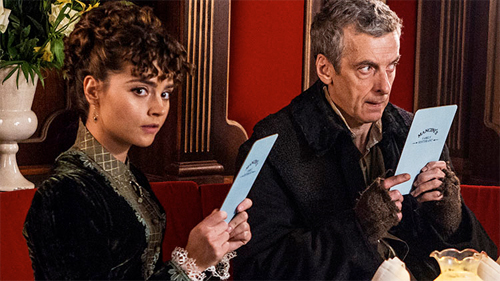
So… what did I think about Mummy on the Orient Express?

Posted on October 13th, 2014 in Culture | 1 Comment »

mummy

Doctor Who eras are defined as much by their titles as anything else. In the Hartnell years (mostly), individual episodes had names whereas whole stories weren’t given any identification on-screen. Thus, the story we know as The Aztecs was broadcast as four episodes titled The Temple of Evil, The Warriors of Death, The Bride of Sacrifice and The Day of Darkness. This has caused a great deal of confusion and controversy about the “correct” titles, which we need not go into now.

Once Troughton took over, simple descriptive titles became the order of the day. It’s about the Ice Warriors? Call it The Ice Warriors then. Set on a Moonbase is it? Wait a tick. The Moonbase will do. Pirates but they’re in space? How about The Space Pirates.

Once Pertwee settles in, the story titles get a bit more dramatic. Alien ambassadors? Nah, let’s go for The Ambassadors of Death. And the trend continued throughout the Tom Baker era. The Deadly Assassin. But aren’t all assassins deadly by definition? Shut up, it sounds great. Once John Nathan-Turner takes over, the story titles become a little more restrained – Full Circle, Black Orchid – or incomprehensible – Kinda, Castrovalva. One word titles become commonplace, especially one-word-two-word titles – Time-Flight, Snakedance, Earthshock.

Under RTD, the titles were far less predictable. Some hysterical – The End of the World – some evasive – The Empty Child. We had “The Doctor” in the titles for the first time and, with Smith and Jones, the letter J. But under Steven Moffat, and especially from Series 7 onwards, there has been an explicit desire on the part of the show-runner to make the title part of the marketing of the episode. What’s tonight’s Doctor Who about? Dinosaurs on a Spaceship! Who could not want to watch that? (Answer, anyone who has watched it once already.)

There’s nothing terribly wrong with that I suppose, but I find it very hard to forgive our illustrious show-runner for not transmitting Neil Gaiman’s brilliant, brilliant story under its correct title Bigger on the Inside.

So, I’m not a huge fan of Mummy on the Orient Express, as a title. It’s a poor gag in the vein of Rubbish of Sherwood, a weird mash-up of two ideas related only by being vaguely contemporary (Howard Carter’s expedition was 1922, Agatha Christie’s Murder on the Orient Express was published in 1934) and sounds rather like a penny dreadful. I was full of foreboding that the cataclysmic show-down between Clara and the Doctor would be ignored and I was jumpy at the prospect of Frank Skinner in a guest part.

The pre-credit sequence is perfectly fine, if rather wasteful of the great Janet Henfrey. A horrible and inexplicable death in the first five minutes is very traditional for Doctor Who, but when Clara and Capaldi emerge from the TARDIS bantering happily, my heart sank. However, this was merely a feint by the production team, since this is intended to be a final trip. Okay, fair enough.

An excellent guest cast fills out the remaining roles – David Bamber, Daisy Beaumont, Christopher Villiers, John Sessions and someone who apparently would like to be called “Foxes”. Plus, seeing Jenna Coleman in that plunging mini dress and then in those silky jamas made me feel a bit funny. Of course, this is the Orient Express IN SPACE!! I’m not quite sure why it has to be IN SPACE!! Except for the fact that not having to show trees rushing by saves on the budget as does not having anyone climbing around the outside, as is generally required of adventure stories set on trains.

The threat is a neatly insoluable puzzle and the Doctor’s approach to tackling it is very interesting. “Mystery shopper” is a cute way to undercut the power of the psychic paper. I’m not sure what suddenly stripping away the holographic set dressing adds to the drama – it did make the mise-en-scene a bit less interesting from that point on.

So, enter Frank Skinner. Far from the catastrophes of stunt casting past (Beryl Reid, Ken Dodd etc), Skinner underplays nicely, with a little twinkle giving away that there is far more to this innocuous engineer than at first glance. Alas, I spotted very early that his only dialogue is with the Doctor, and in a story where the main threat can only be perceived by the person about to die, it was a little too obvious that “Engineer Perkins” was actually a hologram whom only the Doctor could see.

Alright, actually that didn’t happen, but right up till the moment Clara turns to watch him leave the TARDIS, I was convinced it was going to. Watch the episode again – I swear, nobody apart from Capaldi ever acknowledges his presence. David Bamber says “shut that man up” at one point, but even that is ambiguous. Part of the problem is that we quickly get down to half-a-dozen non-speaking extras (if they have even one line of dialogue, you have to pay them more money) but still, I don’t think I’ve ever seen such a clear set-up for a payoff that never arrives before in my life.

Overall then, this is strong stuff. Yet another penetrating look at this darkest of all Doctors, his clear-eyed morality dramatically juxtaposed with his clodhopping bedside manner. An exciting, fast-moving adventure with a neat solution which manages to be tense and fun, all at the same time. An engaging group of supporting characters whom I actually missed when they fell foul of the Foretold and smart, pacey direction that holds the whole thing together.

What takes the shine off a little is Clara’s change of heart at the end. I am tremendously relieved that the events of Kill the Moon have had an impact on the episode(s) which followed, and I don’t object in theory to sending Clara on an adventure which causes her to do a complete volte-face and jump back on board the TARDIS, but I’m not sure this was that adventure.

Anyway, 4½ stars for what is shaping up to be a very strong run of episodes.

Taking a bit of time out and setting up 12 consecutive episodes as well as the remarkable coup of landing Peter Capaldi in the leading part really seems to have re-energised the production team from Moffat on down. Finally, he seems to be finding the balance between a really good story-of-the-week (and they have all pretty much been good-to-great, with the exception of Bobbins of Sherwood), and an engaging season-arc-mystery, while providing genuine character development between the two leads week-to-week.

It may have taken four and a half years and four seasons, but I think Steven Moffat might finally be getting the hang of this show-runner job. I can hardly believe we only have four episodes to go.

So… what did I think of Kill the Moon?

Posted on October 10th, 2014 in Culture | 7 Comments »

killthemoon

Newcomer Peter Harness begins his script in about the least promising way possible. The TARDIS – as well as not housing any hanky-panky – also ought not to be home to moppets. Moppets practically undid a Neil Gaiman script quite recently and I remain stubbornly uninterested on whatever tiresome journey of self-discovery Courtney Woods pleases to be on.

The arrival on the moon is visually stunning however. Really amazing. I’ve said before that the production values of modern Doctor Who are rarely an issue but this is another level. The location filming in Lanzarote, combined with some incredibly elegant pixel-shuffling from Milk, creates an incredible evocation of walking on our satellite. And I would have forgiven them for just ignoring the one-sixth gravity, but actually, the weight of the TARDIS crew turns out to be a plot point.

We then meet the Space Shuttle crew – Captain NotNamedOnScreen and her cohorts Lt FirstToDie and Cpl DontKnowDontCare – who are here with loads of nukes because – blowing up the moon is their last resort. The next twenty minutes is pretty standard run, jump and hide stuff. Some good jokes. Some good scares. Murray Gold, giving it some welly. And then, rather earlier than I expected, the truth is revealed. The moon is an egg. And it’s hatching.

Big problem with this episode #1: Pretty much all of the forgoing is utter bullshit from a scientific point of view.

But… c’mon #1: Basically, all the science in Doctor Who is bullshit. As an anthology show, Doctor Who can and does work in a lot of different genres, but “hard SF” is one it visits very rarely. Even if you give the essentially magical powers of the TARDIS and regeneration a pass, that doesn’t make past plotlines any more plausible. Just so we’re clear – you can’t power travel suits with static electricity, use mirrors to travel through time, maintain a corporeal body with the power of your will, alter the structure of the universe with maths, reassemble a shattered spaceship by gravity, grab a young American botanist with one of your branches if you’ve been turned into a tree, or expect a code-cracking computer to translate ancient languages either. No grand tradition of hard SF concepts has been traduced here, and the notion of the moon as an egg is beguiling, poetic, dramatic and visual. That’s good enough for me.

Building an entire episode around a moral dilemma is bold enough. Having the Doctor abandon Clara, Captain Cold Feet and Moppet to their own devices is incredible. Steven Moffat has talked about finding a Capaldi moment in each episode. Looking the Half Faced Man in the eye while pointing out that one of them is bound to kill the other springs to mind, so does he lack of concern with the fate of Ross in Into the Dalek. “Kill the little girl first,” is chilling enough – but his attitude to the humans here is nothing short of astonishing. Only the Fourth Doctor refusing to assist in the amputation of Winlett’s infected arm in Seeds of Doom even comes close.

Big problem with this episode #2: It’s an anti-abortion parable.

But… c’mon #2: No it isn’t.

Not enough for you? Okay, look of course, abortion flitted through my mind watching this episode, but I dismissed it almost as quickly. The debate here is about whether to murder an innocent creature which is already unequivocally alive. The fact that it is currently inside an egg-shell does not make this action an abortion. The abortion debate hinges on firstly the rights of the mother vs the rights of a zygote (there is no mother here) and secondly the difference between an undifferentiated ball of cells and a unique, viable life, capable of existing outside of its mother (evidently the moon-lizard-bat-thing has reached this point).

In the end, Clara flies in the face of the will of the people of Earth and pushes the big red do-the-right-thing button. We get an appropriately heart-string-tugging ending and –

Big problem with this episode #3: A newly-hatched creature immediately laying a new egg that’s bigger than it is…

But… c’mon #3: See #1.

And then Clara rips the Doctor a new arsehole.

Jesus Christ!

Possibly the rawest scene of the Moffat era, maybe in the show’s entire history, this isn’t the Doctor being a bit moody, this isn’t a companion having a grump, this is a full on, balls-out, emotionally scarring show-down. No companion – no character – has ever called the Doctor on his antics like this, and no incarnation of the Doctor has ever deserved it more. Finally, after a couple of very engaging false starts, the contemporary incarnation of Clara eventually gets something resembling a personality and Jenna Coleman finally gets a scene worthy of her talents.

The whole story is quite an achievement and I can feel my fingers nudging towards the five star key. It isn’t perfect, alas, and the biggest failing is the supporting characters. Hermione Norris grasps at a few flimsy clues in the thin dialogue and manages to carve out something resembling a human. Phil Nice and Tony Osoba do good work, but the script is far too eager to bump them off and so they never get a chance to register. Ellis George grates a little less this time round, but I’m still not absolutely convinced of the need for her to be here.

And I’m assuming the production team will remember that all this has happened and that life on board the Orient Express in Space (why?) on Saturday will in some way reflect this and not show the Doctor and Clara as pals again (I note no Coleman in the trailer). So, on that basis – and aware that the episode has Divided Fandom (no bad thing), I am all-in on Kill the Moon. Five stars. My first since The Girl Who Waited I believe.

So… what did I think of Listen/Time Heist/The Caretaker

Posted on October 2nd, 2014 in Culture | No Comments »

Terrible dereliction of duty around here lately, sorry about that. I think partly because none of these three episodes provoked terribly strong feelings in me. That’s not necessarily a bad thing. As Tat Wood acutely points out in the About Time series, the production team fatally forgot how to churn out good, solid, workaday episodes in the mid-eighties and it nearly ended the programme for good. That’s what these three are – good, solid, workaday episodes in their different ways.

So, for a start I’m not a Listen hater, nor do I think it really deserves to be spoken of in the same breath as Blink. It’s great to see Moffat sit down and write a non-special, non-arc episode and it’s generally good stuff. I don’t subscribe to the notion put forwarded by some bloggers that having Clara give the proto-Doctor nightmares is an enormous ego trip for the writer (“Isn’t my character special? Isn’t my character the most significantest ever?”) but I do think that having already been threaded through the Doctor’s timeline, she isn’t the best choice for this role.

I didn’t mind the Danny Pink soap opera stuff, but I was put out by the fact that an enormous amount of plot hinges on Clara wilfully withholding vital information from the Doctor out of utterly uncharacteristic embarrassment (as noted the part is horribly underwritten, but Jenna Coleman plays her with a forthright vigour which is completely at odds with this narrative choice). And I don’t mind that the whole story is a closed loop, accomplishing nothing by its end, because some of the individual moments are so arresting – notably The Thing Under The Bed Covers – but I desperately care that we were never told what the The Thing Under The Bed Covers was, and I can’t quite escape the suspicion that that question will be answered in a future episode.

Three and a half stars seems miserly for an episode that was so formally daring and so much fun to watch, but four seems over generous given its various flaws. Tell you what, because Young Danny was so brilliantly cast, I’ll bump it up to four.

I’ve had the same conversation with several people regarding the extraordinary find of two Patrick Troughton stories long thought lost (one episode still eludes us). Do you prefer the amazing ambition and individuality of Enemy of the World or do you find more to admire in the way that The Web of Fear is just like every other Patrick Troughton base-under-siege story but so much better? I’m in the latter camp – I can’t overlook the way Enemy trips itself up when the execution isn’t up to the ideas. So I’m perfectly happy with Time Heist being a pretty unambitious by-the-numbers script. It’s chief problem is that it isn’t quite as novel or original as perhaps it thinks it is. There’s actually precious little here we haven’t seen before and most of the twists are pretty easy to see coming. But it clips along very pleasingly, nothing is wasted, nothing is flubbed and it is novel to see the Oceans Eleven genre grafted on to Doctor Who. Four stars seems about right here too.

Finally, The Caretaker. All three of Gareth Roberts’ The-Doctor-Blends-In-With-Earth-Humans scripts have had some basic problems of plot credibility. It rarely actually seems necessary for the Doctor to have to blend in with Earth humans in order to solve the ostensible problem. Of the three, The Lodger is easily the best and Closing Time with its vile love-conquers-all-ending is handily the worst. The Caretaker sits in the middle. Again, it seems utterly unnecessary for the Doctor to either bother to dress up as a caretaker at all, or to be so brazen about it. Clara and Danny’s romance which was tolerable in Listen is really rather irritating here and the Scovox Blitzer is a remarkably generic and unthreatening creation which seems to have been designed by Kroagnon The Great Architect and which would have been much more at home in The Sarah Jane Adventures.

Whereas Time Heist was a romp with a bit of vinegar to balance it out, this is just larks and that’s hard to take over 45 minutes unless the level of invention and humour is absolutely top notch, and here it isn’t. The Doctor continually referring to Danny as a PE teacher is very funny, but the subplot with Courtney the cocky school kid is dull and goes nowhere. Danny Pink’s soldiering which had been a distant bell sounding every so often to punctuate the relationship now becomes a great clanging gong, drowning out everything else about him and the whole thing seems a little short on story for the running time. When it works, however, it works, and I have to give it props for Danny rejecting Clara’s absurd lies about rehearsing for the school play. Three stars seems about right.

So… what did I think of Robot of Sherwood?

Posted on September 11th, 2014 in Culture | 1 Comment »

clara-and-robin

I’m currently listening to a podcast about TV, wherein two (slightly clueless) American chaps discuss the series they are watching at the moment, both recent and current, and offer their views. These young guys have grown up with The Wire and The Sopranos and Breaking Bad and so it’s fascinating to hear them discuss Doctor Who. They’ve been going season-by-season, starting with Eccleston and they’re pretty down on some of the early RTD stuff, although – while they can’t stand Catherine Tate as Donna – they like it more and more as the David Tennant years conclude.

What they don’t seem to get – having never watched the “Classic” Series – is that unlike the heavily-serialised epics of modern US television, Doctor Who has always been designed as an anthology series. So when they complain (and they do) that one episode just seems to completely disregard a previous one, or that no-one has sat down and worked out a consistent chronology of the Whoniverse (no-one who works on the show at any rate), I just want to shout “that’s a plus, not a minus!”

Designing the show as an anthology is what has given it the flexibility to continually reinvent itself, not just Doctor after Doctor, or year after year, but episode after episode. Grim horror follows whimsical fairy tale, follows ripsnorting adventure, follows conceptual sci-fi. By avoiding serialised storytelling, the show constantly opens itself up to new avenues, and by not setting the characters out on a clearly-defined journey, it never needs to end. My big problem with the Matt Smith years was the show was trying to do far more serialised storytelling than was really good for it, and then not really committing to that either.

So, I don’t mind the fact that the supposed “darker Doctor” is taking a week off this week and I don’t mind the fact that this episode is explicitly designed as a “romp”. Both the classic and new series have provided some excellent “romps” including some of my favourite episodes. But this one didn’t really work for me. Unfocused, smug, and seemingly determined to undermine the Doctor at every step. Let’s look at how and why.

Clara’s desire to meet Robin Hood to begin with is utterly arbitrary, further underlining just what a perfect vacuum of a companion she is – by modern standards anyway. Having told her such a thing is impossible, the Doctor manages to land almost on top of the smarmy icon – so clearly something much more is going on here. No, it’s just a coincidence.

As we meet the Merry Men as well as the Outlaw himself, I am ready for one of two different outcomes. Either the promise of the title will be fulfilled and the Doctor proved to be correct – of course this person isn’t the real Robin Hood, that would be absurd – or we will discover that this is the real Robin Hood but that the reality is very different from the myth.

The story at first feints with the first of these – the sheriff’s ship is leaking Robinhoodmium into the area making everything all storybooky – but then parries with the contradictory revelation that, no, this actually is the real Robin Hood. But in that case, you have to give us the truth behind the myth. Simply reproducing the myth and having Peter Capaldi scoff at it is pretty much the Dame Sally Markham school of copy-and-paste scriptwriting.

And while Ben Miller’s performance was perfectly judged, I don’t quite understand what happened to the real sheriff or if there was a real sheriff or really what the hell is going on. I imagine we were meant to find the Doctor’s bantering with Robin amusing – why else have them both chained up for static minute after static minute in the middle of the story? If you did, I’m happy for you. I found Robin profoundly annoying and the Doctor petty and childish in completely the wrong way.

Towards the end, we get a nice shot of them using molten gold to create an intricate circuit to help the ship take off again – heading for the planet Seasonarcphrase. Obviously this requires the gold to be precisely arranged to create the right effect. Except when it doesn’t and the mass of gold aboard the ship is the only important thing, thus allowing Our Heroes to save the day by firing an arrow after it. None of this is properly thought through, none of it makes any real sense, none of it feels grounded or authentic and all of it is irritating, including the Doctor’s spoon-fight with Robin.

It isn’t completely awful. It looks good – as usual – Ben Miller is absolutely excellent and I did like the Doctor’s remote controlled arrow gag, but on the whole and especially after the first two parts, this is limp, throw-away stuff, and labelling it a “romp” can’t begin to redeem it. Better I suppose than Journey to the Centre of My Rectum or The Soggy Pirate Rubbish but that ain’t saying much. Two and a half stars


So… what did I think of Peter Capaldi?

Posted on September 1st, 2014 in Culture | 2 Comments »

deep breath

In all the general delight that Doctor Who is back (yay!) after eight months off our screens (boo!) and that we are getting an unbroken run of episodes this year (yay!) and in the atmospheric autumn months to boot (yay! yay! yay!), it seems to have gone unremarked upon that we are only getting 12 episodes plus the Christmas special instead of the hither-to traditional 13. Perhaps the sprawling 80 minute run-time of the season opener is to blame? If so, I’m not convinced that it’s a good trade-off.

New Doctor stories break into roughly two types. The first, largely out-of-favour now, shakes the Doc up a bit for the first 20 minutes or so and then plunges him in to an adventure which becomes the real point of the story. See Power of the Daleks, Robot and, if it counts, Rose. The other type makes the Doctor’s regeneration and new persona the main point of the story and although there generally is a threat which must be overcome, it’s usually a fairly minor one. See Spearhead from Space, Castrovalva and The Christmas Invasion. In these stories, the Doctor is off-stage, usually incapacitated, for part of the story, and much of the action deals with the consequences of this violent alteration of his body and mind.

Ever eager to have his intricately decorated cake and greedily devour it too, Steven Moffat has inevitably tried to use the extra running time to do both here, and the result is an episode full of marvellous moments, but with some very strange pacing and a couple of choices that seem rather too forced.

I noted around the time of Tennant’s departure the two very different positions adopted by the outgoing and incoming show-runners. “This is a death. The Tenth Doctor will die,” intoned Russell T Davies as he prepared to clear out his desk. “He’s the same man,” reassured Steven Moffat as he tried Rusty’s boots on for size. Now it’s Moffat’s turn to execute a Doctor and he’s no longer prepared to show the process as consequence free.

Capaldi makes an instant first impression, although he’s given fairly generic Moffat-Doctor stuff at first, when he isn’t being given fairly generic post-regenerative-Doctor stuff. There are some lovely one liners in the mix though, especially the bit about the Doctor taking micro-naps while other people are talking. While learning his lines, Jon Pertwee used to rip out all the pages which didn’t feature the Doctor. On occasion he’d wander into the rehearsal room grumbling “very thin script this week.” Once he decides to leave via the window rather than the door, the character starts to snap into focus. It’s around this time that the main science-fiction mystery plot starts to take over, but it’s also remarkable – almost profligate – that the story is willing to introduce a fully-grown tyrannosaurus rex stomping across Victorian London and then toss it aside as a mere curtain-raiser for the supposedly more interesting tale of alien impersonators. Terror of the Zygons didn’t have Moffat’s budget but at least Robert Banks Stewart had the sense to do those things the other way round.

But the middle part of the episode is largely unconcerned with threats sauropodian or other-wordly. Instead we tackle the question above head-on – is this the same man? Clara’s scene with Madame Vastra and her veil is an arresting, confronting and beautifully written answer to this question, serving both to give fans a new take on what regeneration is as well as gently reassuring the little ones that it’s okay to miss Matt Smith and give this new bloke with the scary eyebrows a chance.

The only thing which spoils this scene is that of all the companions the Doctor has ever had, it’s this one who gets to play this scene. Clara the Impossible Girl who has helped the Doctor in every regeneration he has ever had. Clara, who only two stories ago was hanging out with not two but three Doctors and seemed perfectly happy that they were all the same man. Clara who watched the regeneration happen before her eyes, and told the Paternoster Gang in no uncertain times who this wild Caledonian really was. It’s a nice scene, but it’s absolutely impossible to fit it into Clara’s character development so far.

On which subject, there follows another very nice scene in which the Doctor and Clara meet in that weird restaurant. “Game-playing narcissist” is a pretty odd description of the Doctor. “Game-playing” possibly describes the fourth Doctor, certainly the seventh, but “narcissist” sounds totally wrong. And just what has Clara ever done which earns her either of those titles? Clara still has yet to make any characterisation beyond the incomprehensible Impossible Girl nonsense and Jenna Coleman’s winning smile. But it is a nice scene.

Once the main sci-fi plot takes over, the pacing smoothes out and the threat is vanquished in a suitably satisfying manner, with just two little wrinkles. How striking, how fascinating, in an episode devoted to telling us who this new Doctor is, to end the adventure on such a profound note of ambiguity. Both outcomes seem profoundly unlikely – that the Doctor bodily ejected his clockwork nemesis or that such a single-minded automaton elected to terminate himself. I almost don’t want to know the answer – for once the question might actually be more interesting.

What did give me pause is the very final scene with the first appearance of Michelle Gomez as “Missy” who appears to run a version of heaven populated only by people who have died at the Doctor’s hands. This evidently is our season-runner and so far I’m dubious as to its worth.

I’d rather have had that than the very peculiar and unnecessary Matt Smith cameo. Everything was wrong about this. Just when we’d begun to accept Capaldi, his predecessor shows up, bringing back all those tedious memories. The kids who were so subtly reassured earlier now have the message rammed down their throats and the whole thing smacks of “we can so let’s not ask if we should.”

But I’m sounding awfully grumbly about an episode I did like a lot. Ben Wheatley directs with atmosphere and class, the Paternoster Gang are huge fun as ever, Capaldi nails it right from the off and the new TARDIS and titles are lovely, even if the theme music is a bit Dominic Glynn. 3½ stars sounds about right. A promising beginning.

into the dalek

So, let’s go on to what should be an easier job – Capaldi’s second story. There’s not so much to say about this one – Fantastic Voyage inside a Dalek. This aims pretty low – a rollicking adventure with a thin veneer of moral philosophy – but it hits the bullseye pretty much every time. Twelve’s rescue of Journey Blue and his disregard for the fate of Ross are particularly striking. Some of this is by-the-numbers – she’s a soldier but she’s got a conscience (yawn) – some of it feels a bit over-familiar – a lot is cribbed from the end of Dalek, and visually its reminiscent of the Battle of Canary Wharf – but it’s fast-moving, funny, exciting and novel enough to be a thoroughly entertaining 45 minutes of television. Hardly likely to go down as a cast-iron classic but the kind of high-quality work-a-day story which the production team needs to be able to crank out.

The joint writing credit for Phil Ford and Moffat is interesting too. Is Moffat scaling back or is he doing RTD style rewrites now but taking a bigger credit for them? Only Ford was taking the credit on Doctor Who Extra in any case. I can’t quite bring myself to give a shit about Danny Pink, but I daresay he’ll be given something interesting to do at some point.

So, I’m optimistic at the moment. We haven’t managed a complete break with the past (I really don’t care who that woman in The Bells of St John was) but we’ve so far avoided the tangled continuity webs and nonsensical plotting of Time and Day of the Doctor and Capaldi is marvellous in the part. Four stars for Into the Dalek and away we go…

So… what did I think of Name/Night/Day/Time/Space/Hat of the Doctor?

Posted on December 26th, 2013 in Culture | 2 Comments »

cyber-handles-christmas-special-2013

To begin with, the fiftieth anniversary was an extraordinary milestone, celebrated in style. The tweedily earnest Matthew Sweet documentary was lovely; the Mark Gattiss drama was charming and moving, if unseemly brisk; the Peter Davison red button extra was properly hilarious and the Paul McGann mini-episode totally unexpected and absolutely extraordinary. Over the BBC Three post-show party, I must draw a polite veil in the interests of propriety.

What then of the episode itself? Hardly the direct continuation of the Series Seven finale I thought we had been promised. You’ll remember, if not really comprehend, that the Doctor and Clara were trapped, seemingly forever, in some bleak landscape of the Doctor’s own timeline, with no possible means of escape, and facing a hitherto unknown Doctor whose baleful powers were terrible and absolute. Hell of cliffhanger to leave us on. And resolved by – ignoring it completely. Oh well, maybe they weren’t quite as comprehensively trapped as they had seemed. Maybe there was an escape pod (there frequently is).

What we do get is a lovely widescreened version of the original titles, a glimpse of Coal Hill School where Clara The Impossible Girl (I think that’s her surname), her baffling reason-to-be having now been discharged, is working as a teacher. For reasons not clear even when explained, Kate Lethbridge-Stewart finds it convenient to very, very publicly air-lift the TARDIS to UNIT’s top-secret headquarters in order to explain some plot.

And now we meet the other Doctors. David Tennant slips back into the role so effortlessly that it’s easy to miss that Moffat has fallen into the same trap as Bob Baker and Dave Martin, Terrance Dicks and Robert Holmes have before him. The returning Doctor is not written quite as we remember him, but as a rather broader, almost parody version. Tennant’s speech to the bunny rabbit is properly hilarious, but I can’t imagine RTD letting it through under his watch.

“The War Doctor”, as we must apparently call him, is more problematic for various reasons. Firstly, it seemed pretty obvious to me, and Moffat has now confirmed in interviews, that if Eccleston had agreed to come back, this would have been his part, and just as the “together, we’re a match for you” scene in The Five Doctors stumbles a little because Tom isn’t there, so too do the scenes of the three “modern” Doctors creak because we know one of them is a retrofitted interloper.

Far more damaging is the depiction of the Time War itself. As a phrase, as a concept, this fills the mind with all sorts of terrors and wonders. Once shown on the telly it looks like a video game. As another commenter pointed out, the Time War was introduced by Rusty to avoid all the continuity baggage of the Time Lords, but has now become that very continuity baggage.

Pretty soon, The Moment, cheekily played by Billie Piper, is chatting idly with John Hurt – which creates its own problems; surely the Eccelston Doctor would have recognised her in 2005 from this earth-shattering encounter? And before long all three Doctors are cheerfully shooting the breeze. There are some very, very funny lines here, some lovely nods to the fans and some signature Moffat touches with the sonic needing all that time to perform the calculations. And something about some Zygons. But around this point, I began to wonder – where is the urgency? Where is the jeopardy? Where is the threat? Have we finally put The Terrible Apocalyptic Time War on screen in order to turn it into a slightly dull undergraduate ethics class?

The problem is that the notion of wiping out Gallifrey in order to spare the universe, firstly is not adequately spelled out. It’s not really made clear what the Moment is going to do, nor what the alternative is. Secondly, the cost of either choice, not in terms of Universal Armageddon – such a thing is literally inconceivable and therefore undramatic – is not really apparent because the Hurt Doctor is so stoic. Compare his vague mulling over possible outcomes to the agonies which the Eccleston Doctor goes through in The Parting of the Ways as he attempts to decide whether or not to use the delta wave generator. It’s essentially the same plot device, but the extra power of the Davies’ version is hard to miss.

At some point, the Zygon plot rears its head again (even in 75 minutes it feels like there is at least one major plot-line too many here) and the solution provided is genuinely clever and arresting. Such a shame we can’t stick around to see the outcome. And then we pluck Gallifrey out of existence in a Blink-style manoeuvre in order to redeem the War Doctor while not quite unravelling the last eight years of television.

Quite apart from the fact that the entire Dalek fleet simply would not be eliminated in the crossfire, this is a shameless attempt to have one’s cake and eat it too. It undermines the very concept of actions having consequences. It undermines the whole idea of an incarnation of the Doctor who would do unthinkable terrible things (we never see this, the worst he does is graffiti a wall). It undermines the whole idea that the Doctor is alone in the universe. And it doesn’t even make sense.

The scene with the curator is lovely, (now you turn up, do you, Tom? Where were you in 1983?) and the Doctors Assemble shot is a magnificent summation of the series, if slightly-iffy effects-wise and it brings to an end a frustratingly uneven episode. The Fiftieth Anniversary Story had to be so many things to so many people it was almost doomed to fail. It had to be a love letter to the fans, in which it really did succeed. Just by putting Tennant back in the suit, it stood a good chance of doing that, but we got so much else besides. And it had to be an epic turning-point in the history of the show and to tell a really good story. It largely failed in both of these because the former undermined the latter. Take out all the Gallifrey stuff and have Ten and Eleven joining forces to battle the Zygons and you probably have a really good hour. Even with all the Gallifrey stuff, it might have worked if there had only been a greater sense of urgency – if Moffat had been able to make the awful choices faced by his heroes actually feel awful and then avoided that “with one bound they were free” ending.

But Moffat’s work is not yet done. The Christmas special also awaits in which supple, mercurial Smith must give way to Caledonian Capaldi. As is traditional, we start with a companion’s family. As is far from traditional, we also start with a slightly off-colour gag about the Doctor’s nudity. It’s odd that despite two return visits to Clara’s estate (see below) and the plot going to great lengths to remove Clara’s clothes as well, we never get the expected pay-off of both time-travellers returning to Christmas dinner in the altogether.

Thousands of ships are massing around a planet, bewilderingly identified as Gallifrey, later identified as Trenzalore – grave of the Doctor. Sepulchral voices demand to know “Doctor Who?” and so the Doctor has to go down and investigate. Clara and Eleven find themselves enveloped in a truth field, a startling idea which might give rise to all manner of best-kept-hidden secret hopes and fears but which is subsequently entirely ignored.

In fact, what they have discovered is a crack in time, the same crack which was first seen in Matt Smith’s debut episode, The Eleventh Hour, through which the Time Lords are now calling. Before this episode aired, Moffat promised that many unanswered questions would finally be addressed in this story. Good news, if like me you found the endings of the previous three seasons all utterly confounding. But we are no clearer now about what the hell was happening on the shore of Lake Silencio, or just how Amy Pond was able to reboot the universe by getting married, or what Clara Oswald was actually doing which made her so impossible. Instead, various elements of the previous three years are treated more like running gags to be mentioned briefly and occasionally connected to each other, while shedding very little light on anything.

The plot gears grind on and before long place the Doctor in a suitably impossible situation. If he speaks his name, the Time Lords will emerge and the Time War will start again. If he doesn’t the massed forces above will murder the people of Christmas. Unless of course, the Doctor bundles them all into his TARDIS and hides them away somewhere. It’s a bit of a feeble contrivance really, made more feeble by the fact that the murderous alien hoards as presented are so pathetic and easily-defeatable.

In yet another repeat of The Parting of the Ways, the Doctor tricks Clara into leaving not once but twice. It would be bad enough to repeat a story beat almost exactly, and with so little emotional cost; it’s unforgivable when that beat is lifted entirely from an earlier episode, part of whose function was also to regenerate the Doctor. Once again, see how much emotionally welly Russell gives to the Ninth Doctor abandoning Rose, and how little anyone seems to care that the Eleventh Doctor flagrantly breaks his promise to Clara.

That having been said, the scenes with geriatric Eleventh Doctor are some of the episode’s most effective. Old age make-up is always tricky, requiring expert co-operation between actor and prosthetics. Here, as the younger older Doctor (if you see what I mean) Matt Smith’s face sometimes looked unnaturally puffy, but the illusion of the older older Doctor I thought was superbly maintained. And what a clever device it was, I thought, to avoid the fact that Smith is so much younger than Capaldi, to age him almost to death before the regeneration occurs.

The cleverness of this idea is then immediately undermined by the final goodbye scene with the young Matt Smith. As nice as it was to see Karen Gillan again briefly, this scene was too maudlin, too late and had far too many final-sounding lines. Frustrating in an episode which didn’t seem to have time to pay off all its set-ups as it was.

For both these two episodes, then I have very mixed feelings. Professional standards are generally as sky-high as ever (although there was some nostalgically dodgy greenscreen work during the Doctor and Clara’s first entrance into the Mainframe) and the programme can now command top-flight actors in even minor parts – quick shout-out to Kayvan Novak as the voice of “Handles”, a lovely performance – all of the directors are working professionally within the show’s house style, so it’s all up to the scripts and while they both delivered in superficial ways, neither of them entirely made sense, lived up to their promise or created any truly memorable moments.

But, there it is. The Matt Smith era is done. Moffat has done all he is ever going to to tie up loose ends and resolve plots from this part of the show’s history. Having written some of the finest scripts ever for the Ninth and Tenth Doctors, and having cast one of the most unexpected and yet brilliant actors ever to have played the part in Matt Smith, who in turn has given us several stone cold classic episodes including The Doctor’s Wife, A Good Man Goes To War, The Girl Who Waited, The Crimson Horror, Steven Moffat can now leave the show in at least as good shape as he found it, with a strikingly different lead actor and – let us hope – a strikingly different approach to storytelling.

He’s what?

Oh…

So… what did I think about the Name of the Doctor?

Posted on May 21st, 2013 in Culture | 1 Comment »

name

Here it is then. The big one.

I wrote at length about what Doctor Who season finales have become and need to be this time two years ago, so won’t go over all that again. I heard it said recently that a fair reviewer should be trying to tackle the following questions. What was the thing under review trying to do? How well did it succeed? Was it worth doing? To try and tackle the first of those questions, let’s go back to Blink.

Blink is a bit of a miracle in Doctor Who terms. A Doctor-light episode created to solve the problem of shooting 14 episodes in a schedule designed for 13, which Moffat agreed to do to make amends for pulling out of the two-part Dalek story. It’s an elegant puzzle-box of a story which stands entirely outside the continuity of the season and the series as a whole (bridging the gap between Martha’s early and late adventures with Ten) and thus accessible to new and old fans as well as casual viewers. It introduces a new enemy with a genuinely creepy and novel mode of attack, it is terribly funny when it wants to be, it is terribly sad when it wants to be and the resolution is properly thought-through and satisfying. And it gave the world Carey Mulligan (sort-of). It’s pretty much perfect.

And Moffat isn’t exactly unaware of this fact. The Weeping Angels are almost the only monsters he has created and then brought back again. We’ve never seen the Nanogenes, the Clockwork Robots, the Vashta Nerada, the Atraxi ever again, and the Silence were created as villains to sustain a season-arc. And the puzzle-box structure of Blink is evident in a lot of the stories we’ve seen since Matt Smith took over – much more than the love story structure of Girl in the Fireplace for example.

So, here we are at the end of another series. What kind of resolution is Mr Moffat ready to provide, and can it possibly match Blink? Well, it depends what you mean by resolution.

Blink provides a number of puzzles to be solved. How are the Angels able to move without being seen? What has happened to Kathy and why? What about those DVD “Easter eggs”? All of these are given proper, coherent answers, but answering those questions isn’t the same as resolving the predicament. That’s done when the TARDIS dematerialises from inside the ring of Weeping Angels, each of whom is suddenly staring another in the eyes, locking them in stasis forever. It’s a completely logical extension of what we already know about the Angels and it’s entirely obvious – as soon as it happens, but crucially not before. The emotional resolution doesn’t come until Sally takes Larry’s hand. Blink works so well because all three resolutions are present, clear and delivered adroitly.

But lately, Moffat has been mistaking resolution of puzzles for resolution of plots and has been putting puzzles ahead of people. He’s always been a daring formalist but it’s starting to lead him wildly astray.

Let’s take this step-by-step.

First there’s that prologue. Full of fan squee, but some bits work better than others. The colourised Hartnell looks very awkward, and it’s a shame that the Troughton and Pertwee footage is of them looking a bit doddery in The Five Doctors and not when they were in their prime. The extras in funny clothes actually work much better. But it’s hard to say at this point what it all means – what it’s all for.

The meeting of the Paternoster Gang, plus Clara and River, in Slumberspace, is great. Full of Moffat wit and dash, with a hint of tension and pathos too. “I think I’ve been murdered” – golly! (Such a shame she was reset so quickly.) They all meet up at Trenzalore – the one place a time traveller must never go; their own grave. Not sure why that should be. We’ve seen people visiting their own graves before – in fact earlier this series – and there was not so much as a Blinovitch flash, let alone a gang of Reapers. This feels grafted-on.

Much, much better is the Doctor’s tomb – a bloated, ruin of a Police Box, victim of size leakage. Absolutely lovely. And then, oh look, it’s REG as the Great Intelligence once more. Except wasn’t it Ian McKellen who was the Great Intelligence? And why the Great Intelligence anyway? A couple of minor skirmishes on Earth and that was it for ten or so incarnations. Even the Judoon have been in more stories. It might as well have been the Ogrons.

REG needs the Doctor to say his own name to open the doors. Moffat, whatever I think of his approach to Doctor Who lately, was never going to volunteer this information because there are only three options, all awful – his name is “Doctor Who”, his name is “Steve” or is name “Zanthanzanzibarthollberrytrumpettitorpergraviformaquizotl the fourth”. He finds an elegant way of dodging it, and – behold the tomb of the Doctor.

REG jumps in and is able to… actually I don’t know what he’s able to do. Presumably not kill the Doctor in any of his earlier incarnations, because then the current version wouldn’t exist either. But even foiling the Doctor’s foiling of his opponents results in his own death more often than not and sometimes it results in the end of the Universe. So REG has been just generally getting in the way? Helping the bad guys out here and there? Tipping them the wink that they had better watch out for this Doctor feller, but making sure they don’t actually kill him or blow up the universe? Why?

Inevitably, Clara goes after them. So, I guess we do have a solution to the puzzle. Clara is the impossible girl, is present in the Dalek Asylum and Victorian London, looking and sounding like Clara because she entered the Doctor’s timeline. That’s the beginning of a solution to the puzzle, but it’s nowhere like as easy to understand as the Doctor inserting Easter Eggs into the DVDs he knew Sally Sparrow would one day own. And what does it mean for all those earlier adventures?

I thought at one point that every previous companion had some aspect of Clara in them. Moffat has been writing an any-companion who is now Every Companion. (Don’t believe me? Try switching the casting of Carey Mulligan and Jenna Louise Coleman. Doesn’t make the slightest bit of difference does it?) This would make some sense of this entering the Doctor’s time-line business, but makes no sense at all of her appearance in Asylum and The Snowmen. And is at odds with that teaser sequence. On the other hand, the teaser is at odds with every single other episode of Doctor Who we’ve ever seen. And what about the episodes with modern Clara in them? If there is a shadowy timey-wimey ghost Clara looking out for the Doctor and Jo Grant on Peladon, the Doctor and Leela on Pluto, the Doctor and Rose on Satellite Five – is there also a ghost Clara looking out for the Doctor and Clara on Akhaten?

So, we kind-of get the answer to the puzzle, except we’ve waited over half a year for it instead of thirty-odd minutes. But we’re no nearer to resolving the threat – if anything the answer to the puzzle has obfuscated what the threat actually is. And there’s no emotional resolutional at all. Clara is a shape to fit a hole. She isn’t a person, so why would I care when she jumps into that hole and fills it? A shame too that this episode had to be tied to the two rottenest episodes of this half-series, Ringpiece with that godawful leaf and Journey with its appalling reset-button-that-wasn’t.

And then, suddenly John Hurt appears and it’s a cliff-hanger ending.

Wait a minute, how is John Hurt a fucking cliff-hanger ending? Far, far too much of this series has been trying to get an emotional response from the viewer out of casting. We are meant to go “squee” when we see Jenna Louise Coleman in Asylum of the Daleks, when we see REG in The Snowmen and now when we John Hurt as Not-The-Valeyard-Please-Anything-I’ll-Give-You-Money-Anything. But within the context of the story it means nothing at all.

Okay, look, I didn’t hate it. The Paternoster Gang are still a joy and still well-used. Fanboy that I am, I did grin stupidly at that pre-title sequence, the journey to the Doctor’s tomb did feel suitably epic and Richard E Grant is a good actor, well cast, who mounts a credible threat. River’s reappearance as her digital self post-Library­ is a neat spin on the character and Matt Smith is as good as ever. Even the slack editing has been given the week off.

But as far as a star rating goes, well it’s impossible isn’t it? This is all build-up and no pay off. All tickling and no laughter. Which is fine, except that the tickling started in October 2011 in The Wedding of River Song and now we have to wait until November 2013 for the supposed resolution.

I wonder if it will ever come?

So… what did I think of Nightmare in Silver?

Posted on May 21st, 2013 in Culture | 1 Comment »

nightmareSuperstar Doctor Who writers are few and far between. Douglas Adams became a superstar only after writing for Doctor Who. Robert Holmes is only a superstar within the world of Doctor Who. Russell T Davies and Steven Moffat are arguably superstar writers but they also got to run the whole show. Series Five featured scripts from Simon Nye and Richard Curtis, one of which seemed to clip the writer’s wings and the other which seemed happiest when it wasn’t really a Doctor Who story at all.

But Neil Gaiman is a true superstar writer and he’s also a very, very good match for the version of Doctor Who which Moffat is going for – complex but with a fairy tale aesthetic. For a while it seemed as if The Doctor’s Wife (five stars, Tom Salinsky) was set to be a glorious one-off, but the creator of Sandman has been lured back by Cybermen and the results are, if not quite the perfection of Bigger on the Inside (as it obviously should have been called) then still pretty good.

As with his previous effort, Gaiman’s first act is to take the TARDIS somewhere completely removed from any kind of established continuity – a bubble in which he can create an entirely self-sustaining story. This time it’s Hedgewick’s World of Wonders, but inevitably when it’s long-past its best and under military occupation. The break with the past isn’t entirely complete however, as the Doctor and whatshername are lumbered with the two ghastly moppets from the previous episode. Child actors are always dodgy and these two are awkward and cloying simultaneously. Luckily they don’t stick around for long (making me wonder if a version of this script exists without them…?)

We also have a bunch of marines running about the place, and while I’m aware they came in for criticism from some quarters, I adored the idea of crap marines, sent to guard this cold rock as a punishment with pisspoor weapons, very little training and hardly any military skill. Putting them up against the Cybermen made me laugh one minute and gasp in horror the next – that’s pretty much ideal Doctor Who. Putting Little Miss Nothing in charge of them gives her something to do and that’s a good thing I suppose.

So, yes, the Cybermen themselves make a quick appearance. When the Borg debuted on Star Trek: The Next Generation in 1989 (the same year that Doctor Who was taken off the air), many British sci-fi fans commented that they were basically ripped-off Cybermen. Well Gaiman now has taken the opportunity to return the favour – unconsciously, he claims not to have watched much TNG. Actually, there’s another, earlier, probably equally unconscious rip-off – Big Finish already portrayed a Cybermen as a Mechanical Turk in a Paul McGann audio adventure from 2011.

The Borgified Cybermen work wonderfully well, however, storming the compound, upgrading themselves to overcome each new threat. I did feel just slightly that these new metal meanies were starting to become so un-Cyberlike that I wondered if there was any point in re-using them instead of creating new baddies from scratch (see also the Ice Warriors in Cold War). This is especially true when it comes to the hugely emotional Cyberplanner – of whom more in a minute. The one constant in the Cybermen’s history has been their lack of emotion, but here the Cyberplanner rants and raves with the best of the Doctor Who baddies. It’s great, but it isn’t very Cyber. The Cybermites are a brilliant conceit, fantastically well executed however.

The Doctor’s identity crisis is the most outré idea in the whole episode, but thanks to an absolutely astonishing performance from Matt Smith, it’s also the most successful. Fun though the Doctor’s doppelganger in The Rebel Flesh was, this was the real deal, executed occasionally with green screen in a Mara-like Neverwhere, but more often than not just by Smith’s committed performance. And the resolution of the chess game actually makes sense – about to lose the game on the board, the Doctor moves the field of play to the psychological realm, goading the Cyberplanner until he is able to take advantage of a momentary lapse in concentration. It’s brilliant, brilliant stuff.

What I’m less sold on is the Cyber weakness to gold being a software issues (which just makes no sense at all) and the fact that this generation of Cybermen hasn’t eliminated that as part of their constant and unstoppable upgrading.

The ending is a little rushed and throughout there’s some dodgy editing – a persistent flaw in this run of episodes, not sure why.  Fair enough, I didn’t spot Warwick Davis hiding in plain sight, but the conclusion didn’t have as much of a gut punch as I thought it needed, and it’s not at all clear what happened to the TARDIS when the planet blew.

Very, very good stuff then, rather than perfect. Four-and-a-half stars but I’m still waiting for this year’s cast-iron classic.

So… what did I think of The Crimson Horror?

Posted on May 10th, 2013 in Culture | No Comments »

crimson

It’s been a bit of a bumpy ride since the departure of the Ponds. Quick summary – Bells: fun. Rings: horrid. Cold War / Hide: decent. Journey: bobbins. Mark Gatiss certainly knows his Who but his scripts often end up being a little less than the sum of their parts. Still, in the Moffatverse, where we never get only six ideas if nine will do, that may be no bad thing.

This year has also seen the total abandonment of the two-parter. While this means we don’t get one-and-a-half-parters stretched out over ninety minutes (step forward The Hungry Earth / Cold Blood) we also don’t get stories with the depth and complexity of the best of the Tennant era (my personal faves being The Satan Pit and Doomsday). Mark Gatiss’s solution is absolutely brilliant. After a neat cold open which features only the Doctor’s grimacing, er, features, for the first fifteen minutes it’s the Vastra/Jenny/Strax show. The Doctor is kept off the stage for so long I was beginning to think I was watching an episode of Columbo. Then when he finally appears, we effectively get Part One of the story condensed into a two-minute sepia-tinted Previously On Doctor Who montage. It’s a tremendously effective way of delivering maximum plot bang for your tightly-scheduled buck.

And the sight of the Doctor’s scarlet and rigid frame is a genuinely shocking one. No Doctor since Peter Davison has seemed as truly vulnerable as Matt Smith and it really helps to counterbalance all the lonely God stuff when we see him hurt, scared and reliant on his companions for help. Just a shame his recovery was so swift, easy and complete. A crippled Doctor, still regaining the full use of his limbs, would have added much to the final skirmish around the rocket.

So let’s talk about those companions. Vastra and Jenny make a strong first impression, greeting poor feckless swooning Mr Thursday in a manner which put me in mind of Marlowe’s first meeting with General Sternwood in The Big Sleep. They are joined by the redoubtable Dan Starkey as Strax and it feels like we’ve known this team forever. It’s hard to believe that it’s only been two stories. A stark contrast to Clara who continues to be a nothing more than a pleasing blank, played with vim and vigour by Sarah Jessica Parker (that is right isn’t it?) but no more a person that I know and understand than the third Cyberman from the right in Earthshock.

Saul Metzstein directs with panache and pace and his control of tone is precise. Gatiss’s script veers from the happy foolishness of an urchin with an acute sense of direction introducing himself as “Thomas Thomas” to the genuine pain of Ada’s betrayal. Diana Rigg is the big box office draw here, merrily chewing up the scenery as a kind of northern version of the Wicked Witch of the West, but it’s Rachel Stirling (Rigg’s real-life daughter) who really impresses, bringing sincerity and depth to poor Ada’s plight. It’s the last few moments with Ada that lift this story from the level of fun romp to really excellent.

Elsewhere, Gatiss is a veritable magpie when it comes to finding inspiration. This one story contains elements from sources including The Stepford Wives, Frankenstein, Charlie and the Chocolate Factory, Total Recall, Tim Burton’s Batman, The Phantom of the Opera – even Ghost Light! Mrs Gilliflower’s scheme is a direct steal from the James Bond movie Moonraker, even down to the detail of the baddies’ plan being foiled in part when it is revealed that a less-than-perfect specimen in their employ will not be part of the eugenic utopia. But the parts are chosen well, blended thoughtfully and the climax strikes the right balance between all-is-lost and then the solution being not only set up but coming at a cost for a major character. The companions who show up at just the right moment have a reason to be there (unlike in, say, Dinosaurs on a Spaceship) and Gatiss comes up with a plan for the Doctor that’s a bit more than crossing his fingers (as in Cold War) Only Mr Sweet disappoints, another ropey effect in a series that we all thought was past them by now.

This is rollicking stuff, then. Basically a good solid four-star adventure, but I’m going to bump it up to four-and-a-half for the novel structure, the striking attack on the Doctor and for Rachel Stirling’s astonishing performance. And the Doctor’s right – it is a good name.

Next week – Cybermen, yay! But also – moppets, boo! But Neil Gaiman, so yay again. And I’ll try and get the review up before the series finishes too.

So.. what did I think of Journey to the Centre of the TARDIS?

Posted on May 4th, 2013 in Culture | 2 Comments »

tardis

Sh…. spoilers!

Unlike the various incarnations of Star Trek which regularly included “bottle shows” using only the standing spaceship interior sets as a cost-saving measure, stories set largely or completely inside the TARDIS are rare on Doctor Who, despite the fact that the Doctor’s Type 40 is potentially a much more interesting space. Or maybe because of that. Like Gallifrey, the Time War or – nota bene Mr Moffatt – the Doctor’s name, some things are much more interesting because we know so little about them.

So, in the 1960s we had the distinctly peculiar two-parter, The Edge of Destruction, in the 1970s, Tom Baker gave Sontarans the run-around in a very atypical TARDIS in The Invasion of Time and in the 1980s, Peter Davison spent the first two episodes of Castrovalva wandering around the TARDIS impersonating his predecessors. Since the show returned in 2005, however, we’ve almost never seen anything beyond the console room, so we were about due an episode like this.

Regular blog readers (hello!) may recall that I don’t hold Steve Thompson’s last effort The Soggy Pirate Rubbish (I genuinely cannot recall its real name off the top of my head) in particularly high regard, so while I have a definite fondness for stories told within formal constraints and I’m well up for seeing a bit more TARDIS feng shui, I just wish they hadn’t given the job to this guy. TSPR was typified by scanty explanations, very little originality, a fatal lack of follow-through on its few interesting ideas and a general “that’ll do” approach to structure and characterisation. Surely this would be an improvement…?

Well, it doesn’t make a very good first impression. The space haulage team are clumsily-made photocopies of the crew of the Nostromo, even down to the fact that one of them is an android, complete with cute but implausible vocal effect. Better “Tricky” than those appalling would-be comedy robots from Dinosaurs on a Spaceship I suppose, but c’mon. Their ship is equipped with a sort of souped-up tractor beam, which mysteriously comes equipped with a remote control. I cannot think of a single reason why this piece of equipment should require operation from anywhere other than the command deck, especially with more than a one-man crew. As we’ll see, the real reason has nothing whatever to do with logic or world-building, but is simply a requirement to resolve the plot.

The plot firstly requires that make this impossibly, magical, indestructible, engineering miracle of a time-space ship vulnerable to the three stooges’ space-grabby thing. The Doctor, annoyed that the TARDIS and Clara don’t get along, offers to show her how to pilot it, promising he will make it easy by “shutting it down to basics”. In other words, switch off all the automatic safety devices and switching to manual. But isn’t switching to manual what you do when you’re an expert? When you’re a novice, don’t you need as many automatic systems as you can possibly get your hands on? Rather like the Ice Warrior leaving its shell, this action clearly results in the opposite outcome from what was intended, regardless of what the script later claims.

The titles end and we witness the TARDIS being carried hundreds of feet inside the salvage ship by a great claw hammer. Rather than place it conveniently on the deck, this machine ends up dumping the old girl on a big pile of cables. Then I can only imagine that the poor director turned two pages of script at once because somehow we are asked to accept that, while our backs were turned, Clara has been lost in the TARDIS’s labyrinthine corridors, while the Doctor now finds himself buried in the pile of cables and outside his own ship. Try as I might, I can see no way in which this can have happened. Evidently neither could the writer, but that’s what he requires in order to make the story work, so we are just presented with it and have to accept it. Sigh.

The android crew member now announces that the TARDIS is leaking fuel and that Clara will be overcome by fumes. Remember that they believe the Doctor’s ship to be a product of their own technology, a small escape pod just big enough for two. They evidently have no knowledge of Gallifreyan time-space manipulation, and yet on the basis of a glance, van Baalen number one, seems to know more about the Doctor’s ship than he does. Because that’s what the writer requires in order to make the story work, so we have to accept it. Sigh.

The Doctor accepts this diagnosis and rather than fixing his ship which he knows intimately, on his own and in his own time, he decides that he needs to recruit the help of these three shady individuals, who are clearly out for themselves and have already lied to him to protect their own skin. Can’t see anything wrong with that plan – can you?

Why the Doctor needs the Chuckle Brothers is therefore something of a mystery. Why they need this expedition is even more puzzling. The Doctor promises them “the salvage of a lifetime” and the director – doing what the script can’t or won’t – dollies in on Ashely Walters who clearly decides this is worth risking everything for – even though he has no idea what the Doctor is actually promising him and has absolutely no reason to believe him. No, he just goes along with it because – well you get the idea.

Once on board, the Doctor pushes a button and removes the “poison” from the air but announces that the rest of the TARDIS may still be toxic (there’s zero evidence of this at any point in the episode) and so finding Clara must be done swiftly. I would have thought there would be another button there somewhere which would remove the rest of the “poison” too but apparently not. There’s probably a “locate passenger” button if you look hard enough. There is on the Enterprise. (In fact, one of the salvage brothers turns out to be packing one.) And the mission is so urgent, the Doctor is even willing to play around with the TARDIS self-destruct system. 30 minutes to find Clara or we all die. This of course turns out to be a lie. Even this version of the Doctor isn’t quite that idiotic.

So, the set up is dumb, badly constructed and scarcely making a particle of sense, but given we’ve all agreed to get on the train, let’s see if we can’t at least enjoy the ride. And this is the real point of this episode – Clara, plus Huey, Duey and Louey wandering around beautifully designed corridors, bumping into boot closets, swimming pools and libraries of which we’ve often heard tell.

Except that we can’t get on with that because we’re saddled with these characters of the greedy salvage haulers. And you don’t have to be the most brilliant man in the universe to realise that if you let greedy salvage haulers wander around the most incredible ship in the universe, then they will try and carve bits off it to take home. I suppose we should be grateful for some consistent characterisation, but it’s hard not to think that the Doctor must have hit his head a bit harder than we thought. His actions throughout the first fifteen minutes of the story seem designed to make his life far, far harder than necessary.

There’s some nice The House That Jack Built stuff once Gregor nicks the glowy globe thing, but just as the Doctor’s pointless stupidity weakens his character, the TARDIS’s reaction to this threat weakens it in turn. Inside the ship, space, volume even gravity are completely configurable by the ship itself. Guy’s nicked your glowy globe thing? Reverse gravity so it falls out of his backpack. Then burn him up like you nearly did Clara. Why fuck about just making them walk in circles?

And I thought the TARDIS was bust? If it isn’t bust, then the Doctor can fly it to a more convenient location and hunt for Clara at his leisure. But it seems perfectly capable of pulling these sub-M C Escher tricks so just how bust is it? And of course, trapping the Doctor in a maze means he won’t be able to get to the console room to cancel the self-destruct, as possibly one of the Marx Brothers should have noticed. Still maybe they will concluded that the TARDIS will cancel it of its own accord if “she’s” genuinely that self-aware. You see? Once you start trying to make story out of these ideas you have to make them rigorous, and then you run the risk of making them mundane. Thompson needs the capabilities and limitations of the TARDIS to be accurately defined for his story to have any power, but evidently is anxious about binding his successors (or contradicting his predecessors) and so refuses to give us any such clarity.

Now, just being lost isn’t interesting enough, so send in the cheap-looking shambling monsters to menace the interlopers. Director Mat King, possibly aware that this dog of a script has been let down by some shoddy design work shoots them in the dark and out-of-focus but it doesn’t really help. One of them offs Huey (or was it Duey?) which again makes the Doctor’s decision to drag these three reprobates into this environment very, very questionable.

And of course, all of this frantic wandering around, this introduction of morally-bankrupt ship-wreckers, is rendered instantly moot as soon as the TARDIS obediently guides Clara back to the console room. So if the Doctor had jumped in and shut the doors (we’ve seen that damaged or not, it’s as invulnerable as ever, so who cares what the salvage crew try and do to it), Clara would have strolled in about ten minutes later. Job done. Sigh. Sigh. Sigh. Except it isn’t the same console room as the one the Doctor enters later. It’s a shadow… echo… thing… And the TARDIS has done this because…?

Rather than subject you (and me) to much more of this, let’s brush past much of the rest – echoes of the past for no very good reason, steel poles shooting through the walls for no very good reason, and then the genuinely peculiar revelation that yeah, Huey did tell his brother he was an android, BUT AS A JOKE, YEAH?! Moffat is very fond of this Philip K Dick style revelation and with good reason – handled correctly it can be very powerful, as in the case of Oswin the Dalek or poor Miss Kizlet. Here what might have been a neat flip of the android who thinks it’s human never really plays. It doesn’t seem to be a real part of this story and it’s not given sufficient detail to gain any credibility. I mean, be honest, which of us hasn’t tried to deal with the grief brought on by seeing a loved-one suffer a near-fatal accident by attempting to rewrite their entire identity for them. What laughs!

On to the Gantry of Doom. Once again, things we are told in dialogue turn out to have no tangible reality at all. “We can only remain in there for a minute or two or our skin will burn and our cells will liquify,” intones the Doctor severely, but all four then spend many many minutes trotting back and forth, Benny Hill style, without even a wisp of smoke curling up from them. Remember that the apparitions of the Doctor and Clara are because the past was echoing back into the TARDIS? But the golems turn out to be Clara (because one identity crisis is never enough) because now there are echoes of the future too. Why? Does it matter at this point?

And for that matter, just why does being burned up by the Eye of Harmony turn one into a murderous zombie? If there’s enough Clara DNA left for the tricorder to identify, why isn’t there enough for some residual compassion? If her cells have liquified why isn’t she a puddle on the floor?

“Don’t touch each other, or time will reassert itself,” proclaims the Doctor mysteriously, as not-Android-van-Balen bashes the zombie Claras about the head and neck and the two brothers grapple with each other. Who mustn’t touch whom? What will happen should time reassert itself? Is anyone remotely following any of this any more, writer, director and cast included? At this point, the glowy-globe thing suddenly ceases to have any impact on the plot, becoming just another in a long list of ideas that don’t go anywhere or connect to anything in this complete dogs-dinner of a script. It’s also disappointing to see the remaining Val Baalen brothers slaughtered with zero remorse from the Doctor, who tricked them into entering this fatal environment for his own purposes and largely unnecessarily as we’ve seen. That’s more than a sliver of ice in your heart. That’s just being a bastard.

Once we get to the Heart of the TARDIS things improve a little. For once, what we are told actually matches what we see, and the rendering of the exploded TARDIS engine, frozen in time is hugely impressive. But it’s telling that the vision we see here is not a coherent explanation of what we’ve seen before, tying together the loose threads from earlier in the episode. On the contrary, it’s just another new idea stacked on top of an already perilously shaky pile of largely disconnected ideas. And almost as soon as we’ve been taken here, we are taken away by a literal reset button. Okay, Steve Thompson gets a couple of points for bothering to chuck in a couple of lines of dialogue early on to set this up, but instantly loses them again for stealing the key clue shamelessly from Raiders of the Lost Ark.

He then loses more by fudging the reset. At the beginning of the episode we saw the remote control rolling along the floor, so it must have been thrown there by the future Doctor. But we didn’t see the future Doctor whom the past Doctor clearly sees and acknowledges this time. And just what exactly is supposed to have happened when the Doctor presses the button? I think the idea here is just a little cleverer than the execution. By bringing the magic grappling hook’s unnecessary remote control on board the TARDIS, the Doctor is able to give it to his earlier self and use it to switch off the machine before its TARDIS-destroying capabilities are given long enough to do any real damage. But Thompson seems so delighted that he’s been able to generate a reset button that he’s lost interest in how it actually works and so far from seeing Gregor van Baalen mystified at just how another party has managed to take control of his space salvage scoop, seeing the TARDIS freed from its grasp so the Doctor can dematerialise, we just get told that the TARDIS disappeared from the scanner.

And, just as with all good “it was only a dream” endings, we get to have our cake and eat it too. Because of the traumatic experiences that he hasn’t actually been through Gregor van Baalen might be 5% less of a shit from now on. Whoop-de-doo.

So, what can we salvage from this mess? Well, production design and effects were largely up-to-snuff – which used to be a given, but ever since that rotten space bike in The Ringpiece of Akhaten I’m not so complacent. The exception being the Clara-creatures which looked like they could have walked straight off the set of a Jon Pertwee adventure. Matt Smith and Jenna-Louise Coleman continued to give it their all, but the guest cast looked ill-at-ease throughout, and who can blame them with a script that makes as little sense as this?

It’s almost a cliché of the older actor asked to perform in a Doctor Who script that they cheerfully admit they didn’t really understand a word of it, but like an old pro, they manage to look the other actor in the eye and say the lines with conviction. But it’s actually rather atypical of the series that it makes as little sense as this. The Void in Doomsday might be an awfully convenient way of hoovering up an army of Cybermen and Daleks but it has specifically defined qualities and capabilities that do not get rewritten as the plot demands. Time and again in this script, the only explanation for all of the bizarre landscapes and peculiarities visited by the cast is the one word TARDIS and that just isn’t good enough. What’s really unforgivable, however, is the lack of connection between the dialogue and the visuals. If the cast are going into a location hot enough to fry their skin and liquify their body cells, is it asking too much to see their clothing smoulder a little?

So, I’m a grumpy fan today. Exploring the delights of the TARDIS should have been a joy and instead it was nonsense. Worse if anything than Akhaten because it promised so much more. But at least we were spared the earlier story’s glacial pacing, litres of schmaltz and adorable moppety heroine, so it’s probably a wash. Two, very grudging stars.

And whither Doctor Who under Steven Moffat? It really is troubling that for all the effort he has gone to to surround new companion Clara with a mysterious plot, he has apparently forgotten to put an actual person in the centre of it. Mistaking complication for complexity is easily done, but there needs to be some actual human cost to all of this mucking about with multiple Claras and there needs to be somebody reading these scripts who is at least trying to connect the dots properly. Dare I say it – possibly the best thing Moffatt could do now for Doctor Who is to leave after the fiftieth anniversary and let someone else take over.